Malaysia AI Data Centres Put Fibre And Power Supply On Critical Path
Panduit told reporters in Kuala Lumpur that Malaysia’s AI data-centre expansion depends on fibre, rack power and compliant installation as much as headline GPU capacity.

Malaysia's AI data-centre boom has a less visible bottleneck than GPUs.
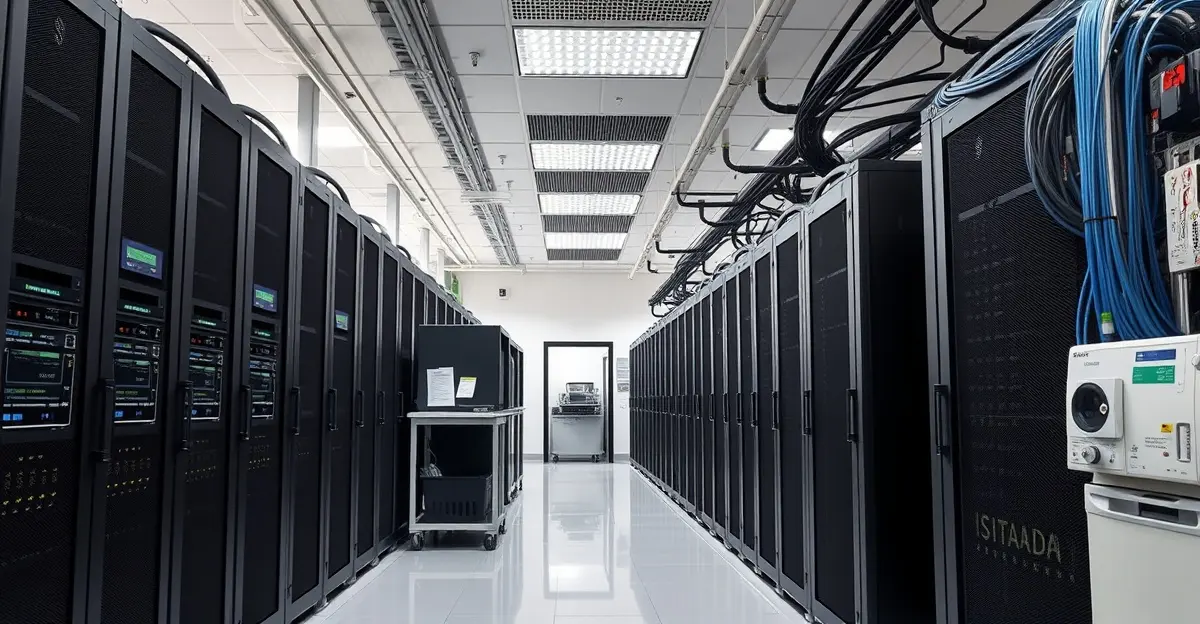
A single AI cluster can require 5,592 fibre-optic connections, while one Johor hall combines 350 clusters with about 150 megawatts of equipment load before customer workloads begin.
Tech Wire Asia's report from a Panduit briefing in Kuala Lumpur presented those figures.
Kevin Choong, who leads the company's network-infrastructure business across Malaysia, Singapore and Indonesia, used the example to show why cabling, connectors and power distribution can determine when expensive compute actually becomes usable.
Fibre Becomes A Deployment Bottleneck
Choong's estimate puts close to 100% of data centres now under construction in Johor Bahru in the AI-workload category.
He expects the AI share of Panduit's data-centre projects to multiply twofold to fourfold over the next two or three years.
Panduit's Malaysian revenue mix already reflects that shift.
Data centres contribute 50% to 55% of local revenue, with manufacturing and commercial sites across Penang and the Klang Valley accounting for the balance.
Chips are only one dependency in that build sequence.
Dense fibre paths have to move data between servers, rack-level power systems have to feed and monitor the equipment, and compliant electrical hardware has to survive the load.
A delay in any one of those layers can leave installed GPUs waiting for the rest of the site.
Power And Cooling Lines Stay Separate
Panduit's role has a clear boundary.
The company occupies the network-cabling layer and largely complements low-voltage electrical suppliers such as Schneider Electric.
Their overlap is concentrated in intelligent power-distribution units, the rack-level equipment that supplies power to servers and tracks consumption.
Cooling sits outside most of that remit.
Panduit provides data connections for monitoring and automation.
Specialist cooling systems supply the thermal engineering needed to keep high-density AI racks from overheating.
Choong attributed some failures discussed at the briefing to non-compliant products, separating those incidents from the volume of AI prompts reaching a site.
The briefing demonstrated that argument with a cable-cleat test in which a compliant installation contained a short circuit and a non-compliant one failed.
Speed Becomes The Customer Test
The tighter supply-chain risk begins before cables reach a project.
Simin Sirun, who oversees Panduit's business across ASEAN, India and Korea, identified high-grade glass used to draw optical fibre as the scarce input while AI construction in the United States and China draws from the same material base.
Panduit holds stock in Singapore and China and buys glass early once customer scopes are known, locking in supply and price before a site is ready.
Its Malaysian distributor is also carrying unusually high inventory.
Local execution capacity gives the supplier another buffer.
Panduit presented a Malaysian footprint spanning more than 25 years, about 45 accredited installation partners, a 25-year system warranty for certified sites and around 200 employees at a Johor plant that replaced a former Singapore facility.
Sirun gave no figure for the plant's size or share of output.
Customer pressure now lands on time.
Choong said buyers now prioritize lead time over price.
He presented the 350-cluster Johor hall as a sequence: secure fibre glass, monitor rack power, complete a compliant installation, then bring customer workloads online.