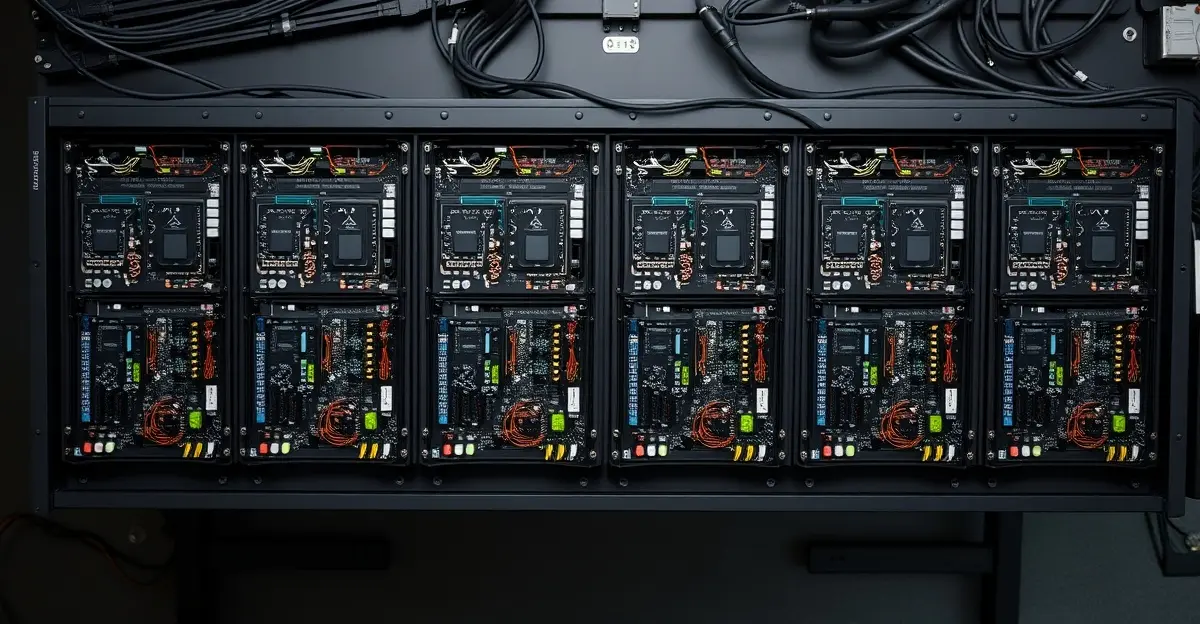
Armenia AI Plan Centres On Blackwell Compute, Not Chip Fabrication
AI News places Armenia’s Firebird plan around imported NVIDIA Blackwell infrastructure, US export approval and power capacity rather than domestic chip manufacturing.

Armenia's planned AI hub is being framed as a semiconductor story, but the disclosed evidence points to a different constraint: imported compute, export approval, power and network capacity.
AI News places the Firebird project near Hrazdan around NVIDIA Blackwell infrastructure rather than chip fabrication inside Armenia.
The source-backed figures describe a data-centre and cloud-infrastructure buildout.
Armenia's Ministry of High-Tech Industry said the first Firebird AI centre phase is scheduled around 2026 and carries a $500 million investment, more than 6,000 NVIDIA Blackwell GPUs, 18 MW of capacity and up to 110.6 exaflops of FP4 Tensor compute.
Imported Blackwell Systems Drive The First Phase
NVIDIA places Blackwell GPU production on a custom TSMC 4NP process, leaving the chip-production chain outside Armenia.
The Armenian project is instead built around hosting high-end systems, with Firebird operating between San Francisco and Yerevan and Dell Technologies appearing in the server layer identified by the article.
The ministry also gave a much larger second-phase figure: about $4 billion in total investment and more than 41,000 additional GPUs.
Those numbers would give Armenia an unusually large AI-compute footprint for its size, but they still describe installed infrastructure and access to accelerators, not a domestic fabrication base.
The US-Armenia AI and Semiconductor Innovation Partnership memorandum of understanding signed on August 8, 2025 gives the project a policy channel.
The MOU covers secure chip supply chains, electronics and integrated-circuit development, AI commercialisation and Armenia's treatment under the US export-control framework.
Export Approval And Power Capacity Shape The Deployment
Independent regional reporting gives the plan a regulatory and supply-chain boundary.
Eurasianet reported in November 2025 that US regulators cleared transfers of advanced NVIDIA chips to the Armenian AI hub, while identifying Dell's PowerEdge role and the political importance of that approval.
OC Media reported, citing Bloomberg, that the project pairs NVIDIA Blackwell chips with Dell AI servers inside a 100 MW data centre, with first-phase timing expected in 2026.
That account also placed the approval in the context of US restrictions on high-performance AI-chip exports to certain countries.
Power and cooling remain part of the deployment test.
The article estimates that a 100 MW data centre could use electricity comparable to a city of about 120,000 people.
Armenia's ministry presents the Firebird site as using a closed-loop water-cooling system that requires water changes only every few years.
Sovereign Compute Depends On Local Access
The business logic is not only capacity.
The article links Firebird to Armenia's software engineering, electronic design automation and diaspora-connected technology base, including Synopsys Armenia's local R&D and product-support operations across Yerevan and Gyumri.
Compute access is the missing layer in that model.
Local startups, universities and public-sector AI programmes need GPUs, network capacity and stable export permissions if the infrastructure is to become more than a hosted cloud project for foreign customers.
Telecom infrastructure is part of the same operating path.
Armenia's ministry links Team Telecom Armenia to next-generation fibre-optic work with bandwidth of up to 1 Tbps.
Some capacity could go to domestic users, while the remainder could be sold to US-based companies operating in the region.
The disclosed record does not yet show customer contracts, domestic allocation terms or pricing for Armenian users of the Firebird capacity.