AI Rack Density Pushes Data Centres Toward Power and Cooling Limits
Data Center Knowledge analysis shows AI rack power moving from typical 11 kW rooms to 100 kW-plus deployments, with cooling, power distribution and grid access setting the ceiling.

AI rack density is moving beyond the power profile most data centres were built to support, Data Center Knowledge reported in an analysis that puts electrical delivery and failure planning ahead of raw chip count as the main deployment limit.
The scale gap is already visible.
Uptime Institute placed 2026 modal rack density at 11 kW after a 9 kW level a year earlier, while Nvidia's GB300 NVL72 reference design requires up to 142 kW per rack.
Nvidia's Vera Rubin NVL72 platform entered full production in June 2026 for cloud-provider shipments this fall, and trade-press supply-chain accounts place its expected rack draw between 190 kW and 230 kW.
The next planned jump is larger.
Nvidia's Rubin Ultra NVL576 Kyber rack is specified at roughly 600 kW for the second half of 2027, a level that turns density from a server-design question into a facility-engineering problem.
Cooling technology explains part of the ceiling.
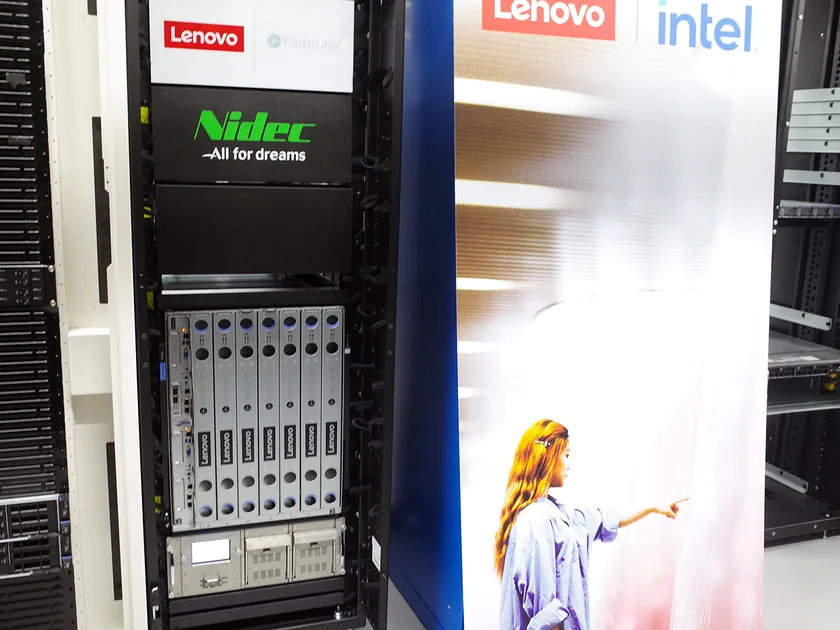
Air cooling becomes impractical above roughly 50 kW per rack, and cold-plate liquid cooling now handles roughly 100 kW to 150 kW per rack.
Schneider Electric put cold-plate systems at 55% market share in 2026, making them the dominant liquid-cooling method for high-density deployments.
Other cooling paths remain less settled.
Two-phase immersion lost momentum after PFAS restrictions disrupted coolant supply, even though a replacement fluid was qualified in early 2026.
Microsoft and Swiss startup Corintis reported September 2025 lab tests showing chip-level microchannels with roughly triple the heat-removal performance of a standard cold plate, but IBM executive Omkar Nimbalkar characterized microfluidics as a technology still several years from mainstream deployment.
Power distribution is becoming just as binding as heat removal.
Legacy 54 VDC distribution becomes impractical once racks move above about 200 kW because the copper needed for that current is too heavy and unwieldy.
A typical power distribution unit handles about 20 kW with double redundancy, while servers can draw up to 6 kW each, leaving resilience planning to determine how much compute can safely keep running after a power-supply failure.
The industry is trying to close that gap with higher-voltage systems and rack-level changes.
Vera Rubin NVL72 ships with 800 VDC, and Vertiv, Schneider Electric, Eaton and Delta have commercial 800 VDC offerings scheduled for the second half of 2026.
Foxconn's 40 MW Kaohsiung-1 facility in Taiwan is being built for that transition, while the Open Compute Project's Mount Diablo specification reached version 0.7.0 in March 2026 and Microsoft and Meta demonstrated working hardware in July.
Grid access remains the facility-side constraint.
Lawrence Berkeley National Laboratory's Queued Up report placed more than 2,060 GW of generation and storage in U.S. interconnection queues at the end of 2025.
Axe Compute CEO Christopher Miglino said the operational question is not only how many megawatts a campus has on paper, but how much power can be delivered, cooled and operated reliably.
The likely near-term baseline is still far below the most aggressive roadmaps.
Nimbalkar expects a typical high-density AI rack in 2028 to be a 100 kW-plus deployment with direct liquid cooling, 400 V power delivery and firmware-level failure handling.
Joseph Wolff of eRacks Systems expects most enterprises to remain on air-cooled 4U nodes at about 4 kW per box, while a smaller group of headline AI racks moves well past 100 kW.