SK Hynix Puts $720B Memory Buildout Behind AI Chip Demand
CNBC reported that SK Hynix is investing $720 billion in South Korean memory factories as AI demand tightens high-bandwidth memory supply and pushes chip buyers toward longer contracts.

SK Hynix is turning the AI memory shortage into a factory-building race, with a $720 billion investment plan for South Korean memory sites that CNBC reported after touring the company's Yongin and Cheongju operations.
The project is meant to expand high-bandwidth memory capacity while AI chipmakers compete for supply.
The scale reflects how far memory has moved from a commodity cycle into an AI supply bottleneck.
Over the past year, SK Hynix has grown into a company worth more than $1 trillion, while Counterpoint Research put its first-quarter HBM share at 58%, ahead of Samsung and Micron at 21% each.
That lead is being financed through capital markets as well as factory work.
SK Hynix raised $26.5 billion in July through a Nasdaq listing, setting a record for foreign-company fundraising on U.S. exchanges.
The newly listed shares have since fallen about 21% from an almost $195 July 14 high, leaving the trade sensitive to broader AI-chip volatility.
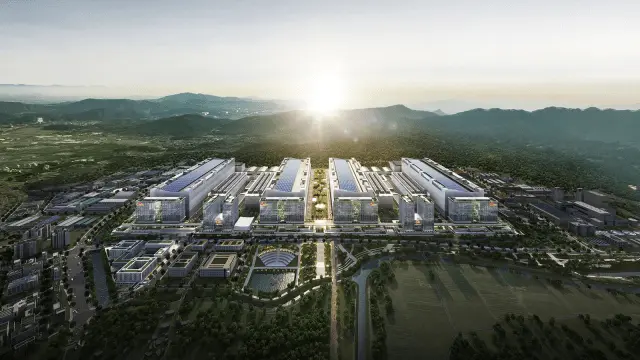
The Yongin Cluster shows the construction problem behind the market numbers.
The first fab had walls only partly built inside a vertical structure planned to rise as high as a 50-story apartment tower, with six cleanrooms connected over several floors rather than spread across a single-story campus.
The design choice is tied to South Korea's land constraints and to the urgency around HBM.
The memory is built by stacking DRAM so AI processors can access data quickly, and the surge in HBM demand is drawing DRAM away from consumer electronics while AI companies lock in longer supply contracts.
SK Group chairman Chey Tae-won framed the scramble as a supply fight in Seoul.
"It's like a war," he said.
Companies cannot produce AI computing and AI chips without the memory, and prices rose too fast.
SK Hynix said in July that it had signed 10 long-term customer agreements.
Nvidia also secured stable HBM supply and agreed to co-develop next-generation memory under a $500 billion SK Group deal that includes data centres with SK Telecom by 2027.
The national policy layer is moving in the same direction.
South Korean President Lee Jae Myung's June memory plan would lift national output to twice its current level within five years, and Samsung is also part of that megafab push as the U.S. pursues new Micron capacity in Idaho and New York.
Geopolitics limits how much of the race can move through China.
SK Hynix runs three fabs there, but U.S. export controls bar it from selling leading-edge HBM into the country.
Counterpoint Research director MS Hwang said China has become the counterparty in the race, even as U.S. projects remain years from full output.
SK Hynix's American footprint is still more about packaging and AI storage than front-end memory manufacturing.
Its $4 billion West Lafayette, Indiana, packaging facility is scheduled to finish construction in 2028, while the Intel NAND business it bought for $9 billion became Solidigm and was reorganized in January into a $10 billion U.S. "AI Company."