Quantum Data Centre Push Shifts From Qubit Counts To Hybrid Workloads
Data Center Knowledge reported that quantum computing work is shifting toward hybrid systems that connect QPUs with GPU and CPU infrastructure. Hyperion estimated the market at $1.4 billion in 2025 and projected about $3 billion by 2028, while the article did not identify production customers, signed deployment contracts or facility-level power loads.
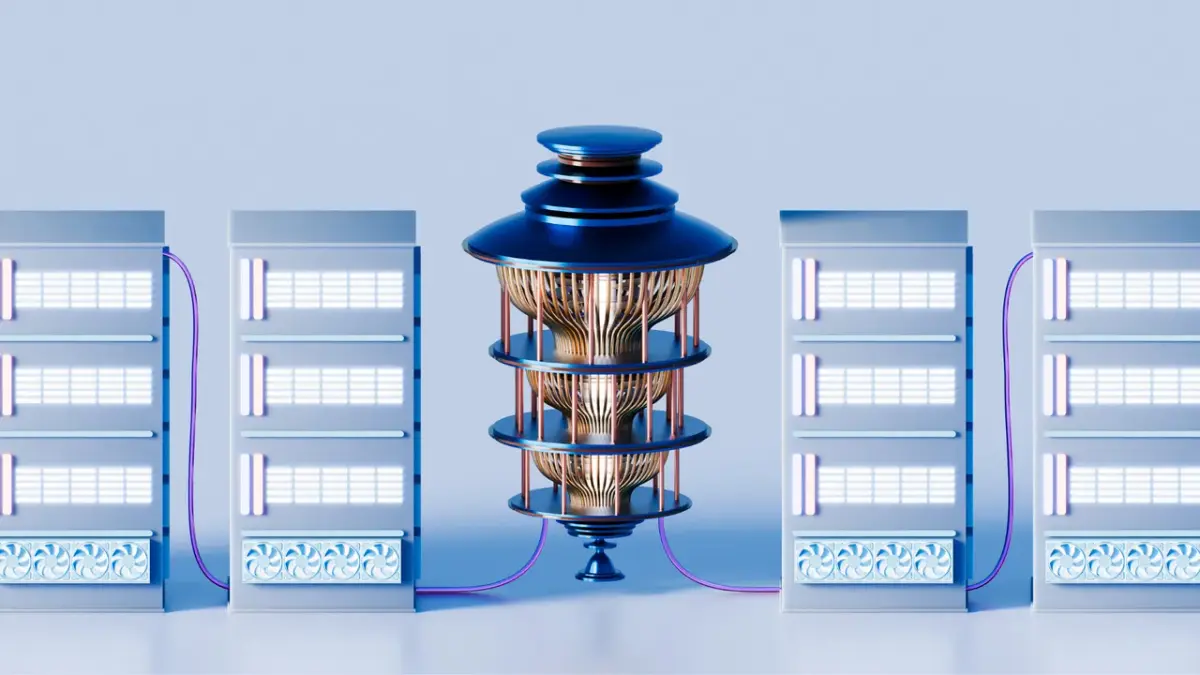
Quantum computing is moving toward hybrid systems that connect quantum processing units with GPU- and CPU-based infrastructure.
Data Center Knowledge reported that the near-term test is no longer simply how many qubits a machine has, but how well it can operate inside existing data centre and supercomputing environments.
That shift makes integration part of the deployment itself.
Superconducting, trapped-ion, neutral-atom, photonic and silicon-spin systems have different cooling, vibration, thermal and operating requirements.
A quantum processor may need to work alongside conventional compute nodes while data remains in standard data centre databases.
Integration Becomes the Near-Term Test
Bob Sorensen, chief quantum computing and AI analyst at Hyperion Research, told Data Center Knowledge that qubit counts are becoming less important as end users focus on introducing quantum computing into classical compute environments.
At Quantum.Tech World in Boston in June, McKinsey partner Henning Soller said integration with high-performance computers and classical infrastructure would be needed before the industry could have clearer evidence of quantum advantage, potentially in the 2028-2030 timeframe.
McKinsey research indicated that colocating quantum systems with classical infrastructure can improve hybrid performance for certain workflows by reducing communication latency.
That benefit depends on the workflow and does not establish a universal performance result.
Market Signals and Vendor Activity
Hyperion estimated the quantum computing market at $1.4 billion in 2025 and projected a 30% annual growth rate to about $3 billion by 2028.
Digital simulators based on CPUs and GPUs accounted for almost one-quarter of the quantum computing hardware market it tracks, with GPUs outpacing CPUs by roughly 2x in that segment.
The vendor activity reflects the same direction.
The article listed IBM work on quantum-centric supercomputing in March 2026, Nvidia NVQLink for connecting QPUs to GPU supercomputers, HPE collaboration with Intel, IQM, Qblox, Quantinuum, QuEra Computing, Quantum Machines, Rigetti and Riverlane, and AMD work with OQC and JPMorgan Chase on quantum, AI and high-performance classical infrastructure for financial services workloads.
Power, Cooling and the Deployment Boundary
A May 2026 Department of Commerce announcement included more than $2 billion in incentives for quantum commercialisation, quantum manufacturing and utility-scale fault-tolerant systems.
A June 2026 White House executive order addressed quantum innovation, practical components, supply-chain procurement and infrastructure security.
Aparna Prabhakar, chief strategy and sustainability officer for Schneider Electric's energy management business, told the Boston conference that operators should take power and cooling requirements seriously as quantum moves from lab to production.
Teams should assess whether cooling approaches require slab-level changes and how operators can mitigate vibration.
Peter Shor, the MIT mathematician behind Shor's algorithm, said relatively few quantum algorithms have emerged and that broader hands-on access to quantum systems may help discovery.
The coverage did not identify named production data centre customers, signed deployment contracts, facility-level power loads, commercial pricing or measured customer performance results for the hybrid systems discussed.