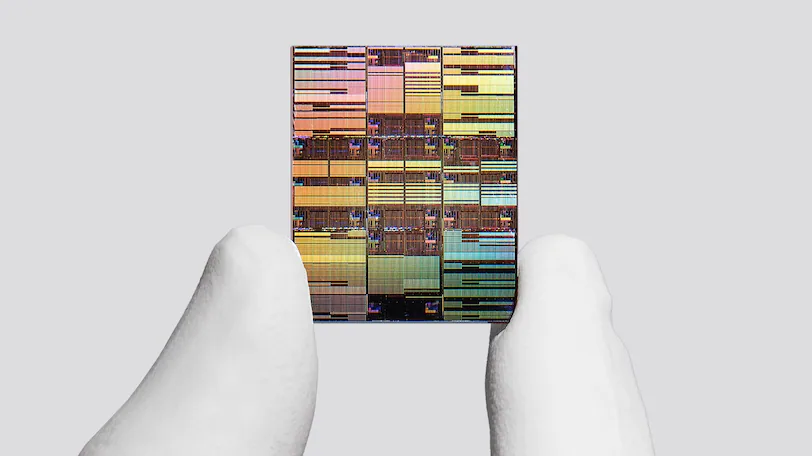
Alibaba Sets 10-Trillion-Parameter Qwen Path With New Zhenwu AI Chip
Alibaba used its Apsara Conference to pair a Qwen model road map with the Zhenwu V900 AI chip, larger cloud capacity plans and a T-Head processor schedule running into 2028.

Alibaba Group Holding used its Apsara Conference in Hangzhou to widen its AI stack, introducing a chip it billed as China’s most powerful while setting out a Qwen model road map that could reach 10 trillion parameters, the South China Morning Post reported.
The announcements put three pieces of Alibaba’s machine-intelligence strategy on the same stage: larger models, proprietary processors and cloud capacity.
Chairman Joe Tsai framed the push as a full-stack investment meant to move AI from technical progress into business value.
Chief executive Eddie Wu Yongming put the company’s model work, custom silicon and cloud build-out at the center of that strategy.
The model plan centers on Qwen 5, which Alibaba’s Qwen team intends to train with 5 trillion to 10 trillion parameters for complex tasks over extended periods.
That would move beyond Qwen 3.8-Max, Alibaba’s current flagship system with 2.4 trillion parameters.
The Artificial Analysis Intelligence Index places that model behind only one Chinese system, while Moonshot AI’s Kimi K3 is larger at 2.8 trillion parameters and is described as China’s biggest open-weight model.
Liu Dayiheng, who leads the Qwen large language model project at Alibaba Token Hub, outlined the sequence through Qwen 4, Qwen 4.5 and Qwen 5.
The presentation also pointed to recursive self-improvement using empirical feedback and upgrades across speech, vision and multimodal systems.
Alongside the frontier-model work, Alibaba launched Qwen Intelligence, a full-stack agent platform for smartphone makers building Qwen-powered AI phones that can execute tasks across apps.
The hardware pitch is meant to reduce the gap between model ambition and domestic computing capacity.
Alibaba’s new Zhenwu V900 processor was presented as a major step up from the Zhenwu M890, with the company claiming three times the predecessor’s performance.
Clusters based on the V900 can link as many as 500,000 chips for both training and inference, creating a path for frontier workloads that are less dependent on foreign accelerators.
T-Head, Alibaba’s semiconductor subsidiary, gave the chip road map a timetable.
For the V900, T-Head listed 216GB of high-bandwidth memory and a 1.2TB-per-second link between chips.
Mass production and commercial availability are scheduled for the first quarter of 2027.
The next-generation Zhenwu J900 is planned for the third quarter of 2028, and the Yitian 720 and Yitian 730 central processors for agentic AI tasks are due in 2027.
The Yitian 730 would be T-Head’s first CPU built on an in-house microarchitecture.
Cloud capacity remains the third leg of the plan.
Alibaba aims to scale global data-centre capacity for Alibaba Cloud to more than 20 gigawatts by 2032, matching the more power-intensive infrastructure needs that come with larger models and domestic chips.
Wu also said annual AI chip shipments should increase significantly, though no specific target was given.
The road map lands in a competitive Chinese AI infrastructure market.
Huawei Technologies last week unveiled its Atlas 960 SuperPoD cluster based on Ascend 960 chips, and its rotating chairman Eric Xu Zhijun expected a major domestic shift toward Huawei infrastructure for model training next year.
China’s most advanced models are still being trained on Nvidia processors despite US export controls, ’s prior reporting.
By midday in Hong Kong, Alibaba shares were trading 3 per cent higher at HK$166 after the announcements.