SendTech Times
Analysis
SYSTEMS SHIFT:

Zyphra’s Zamba2-VL Tests Hybrid AI For Faster Vision-Language Models

Newsroom brief

Zyphra released Zamba2-VL, an open-source vision-language model family that uses a Mamba2-transformer hybrid architecture to target lower-latency multimodal inference for documents, OCR, counting and edge AI tasks.

Verified against source materialEdited by SendTech Times AI & Enterprise DeskSource: AI Times Korea
Zyphra’s Zamba2-VL Tests Hybrid AI For Faster Vision-Language Models
Image source: AI Times Korea

Zyphra Pushes Hybrid Models Into Vision-Language AI

Zyphra has released Zamba2-VL, an open-source vision-language model family built around a hybrid Mamba2 and transformer architecture.

The launch puts the startup’s Zamba2 backbone into multimodal AI, where models must read images and text together rather than handle language alone.

The release covers three model sizes: 1.2B, 2.7B and 7B parameters.

Zyphra made the models available on Hugging Face under the Apache 2.0 license, giving developers a route to test the architecture without waiting for a closed commercial deployment.

Why The Architecture Is Different

Zamba2-VL keeps the familiar LLaVA-style pipeline for multimodal work.

A pretrained vision encoder extracts image features, a lightweight MLP adapter maps those features into the language model’s embedding space, and the language model processes image and text tokens together.

The model supports single-image analysis, multi-image understanding and object grounding.

The change sits inside the language-model backbone.

Zamba2 uses Mamba2 state-space layers for most computation and inserts a shared transformer attention layer after every six Mamba2 layers.

The shared-weight design is meant to reduce memory-bandwidth pressure while preserving some transformer strengths.

That design targets a specific bottleneck in vision-language AI.

High-resolution images, documents and video-style inputs can create thousands of vision tokens, which makes transformer-only inference expensive as sequence length grows.

Zyphra’s claim is that the Mamba2-heavy structure gives Zamba2-VL near-linear prefill behavior and a fixed-size recurrent state.

Benchmarks Put Efficiency Beside Accuracy

Zyphra trained the model family on 100 billion vision-text and general-text tokens from public web datasets.

Its evaluation suite used 14 benchmarks, spanning document and chart tasks as well as visual reasoning, OCR, grounding and counting.

The strongest published figures are in counting and document tasks.

The 1.2B model scored 62.5 on PixMoCount, ahead of InternVL3.5 at 32.8 and PerceptionLM-1B.

On CountBenchQA, the 2.7B and 7B models scored 87.5 and 90.6.

The 2.7B model also reached 90.9 on DocVQA.

The efficiency claim is the more strategic part of the release.

Under a 32,000-token input setting, Zyphra said Zamba2-VL achieved at least 10 times lower TTFT than comparable transformer-based models while maintaining similar accuracy.

That does not prove broad production readiness, but it gives developers a concrete benchmark to test against long-context visual workloads.

Edge Deployment Is The Practical Test

The smaller Zamba2-VL models are aimed at deployments where latency and memory matter.

Zyphra named smartphones, industrial edge equipment, PDF analysis, automated receipt and invoice handling, and inventory or product-counting workflows as target use cases.

Those applications explain why a 1.2B or 2.7B model matters more than headline scale.

If the architecture can keep useful OCR, counting and document performance while cutting first-token delay, it could fit devices and edge systems that cannot afford heavy transformer inference.

What matters now is external validation.

The models are open under Apache 2.0, so What matters now is whether independent developers can reproduce the 32,000-token TTFT advantage and the DocVQA, PixMoCount and CountBenchQA results in real multimodal applications.


Share this article
inXf

Related articles

More
Google Tests Local AI Demand With Gemma 4 12B Release
AI

Google Tests Local AI Demand With Gemma 4 12B Release

Google released Gemma 4 12B as an open-weights multimodal AI model designed to run locally on a standard enterprise laptop. The model is described as an 11.95-billion-parameter system with an Apache 2.0 license, 16GB memory target, 256K context window and immediate availability through Google AI Edge Gallery. The practical question is whether enterprises use local multimodal inference when cloud access, latency or data handling are constraints.

Om AI Bets on Edge Multimodal Models as China AI Startups Move Toward Deployment
AI

Om AI Bets on Edge Multimodal Models as China AI Startups Move Toward Deployment

Om AI Technology is focusing on compact edge-side multimodal vision models for PCs, cameras, robots and other devices rather than very large cloud models. At BEYOND Expo 2026, the company showed OttoBox AI Studio, a local-AI content tool for video analysis, asset matching, script generation and fast production. The next test is whether its VLX edge multimodal model can improve video understanding and decision-making while keeping operating costs lower.

CoRover’s Offline AI Push Tests India’s Edge Deployment Case
AI

CoRover’s Offline AI Push Tests India’s Edge Deployment Case

CoRover AI is pitching on-device and on-premise deployment as a practical answer for banks, hospitals, defense users and rural infrastructure, with CEO Ankush Sabharwal arguing that narrower models can improve reliability when cloud connectivity, compliance or latency become constraints.

liko.ai Funding Turns Edge AI Into a Smart-Home Hardware Test
AI

liko.ai Funding Turns Edge AI Into a Smart-Home Hardware Test

liko.ai completed its first-round financing to fund edge-side vision-language models, AI-native hardware and multi-modal home terminals. The investor group includes Shangtang Guoxiang Capital, Orient Fortune Capital, iFlytek Venture Capital, Hongtai Fund, Zhengxuan Investment and Mianbi Intelligence. The practical question is whether the startup can turn camera-based edge AI into a consumer smart-home hub without relying on cloud processing.

Nota Runs VLA Robotics Model in Real Time on Qualcomm Edge AI Hardware
AI

Nota Runs VLA Robotics Model in Real Time on Qualcomm Edge AI Hardware

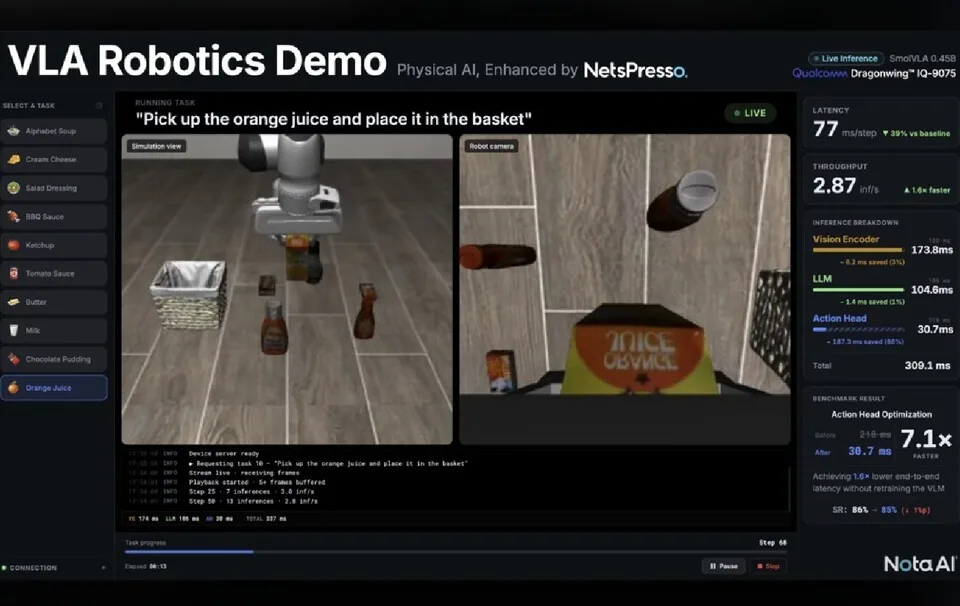
Nota demonstrated real-time operation of a vision-language-action robotics model on Qualcomm Dragonwing edge AI hardware. The company reduced the model action-head processing time from 218 milliseconds to 31 milliseconds while keeping task success nearly unchanged. The demo points to a path for physical AI systems that can run closer to robots rather than relying mainly on GPU servers or cloud infrastructure.

NVIDIA Tests DFlash To Cut LLM Inference Bottlenecks
AI

NVIDIA Tests DFlash To Cut LLM Inference Bottlenecks

DFlash replaces sequential speculative drafting with block-diffusion token prediction on NVIDIA GPUs, aiming to raise throughput for latency-sensitive coding, reasoning and agent workflows without changing the target model output path.

Saudi DISAI 2026 Turns AI Startup Support Into An Edge-Prototype Test
AI

Saudi DISAI 2026 Turns AI Startup Support Into An Edge-Prototype Test

Qualcomm, Aramco, RDIA and HUMAIN have selected ten startups for DISAI 2026, giving Saudi Arabia's AI and deep-tech accelerator a second-year test built around edge AI platforms, infrastructure access, IP training and prototype delivery.

Z.ai GLM-5.2 Pushes Open Coding Models Into Longer Workflows
AI

Z.ai GLM-5.2 Pushes Open Coding Models Into Longer Workflows

Z.ai released GLM-5.2 under an MIT license with a one million-token context window, coding-agent benchmarks and self-hosting options, putting long-context software engineering back into the open-model race.

Keep Reading

More Stories

Latest
Ethereum Testnet Update Targets 200 Million-Gas BlocksCrypto/Web3Oct 6, 2026Ethereum Testnet Update Targets 200 Million-Gas BlocksEthereum developers released Prysm 7.2.1 so the Sepolia trial of Glamsterdam can test 200 million-gas blocks, more than three times the prior 60 million setting, before any main-network change.Kepler Targets 2027 Production for HBM Replacement MemoryCloud & Data CentersOct 6, 2026Kepler Targets 2027 Production for HBM Replacement MemoryEE Times reports that Kepler Computing is preparing 3D ferroelectric memory for 2027 production, promising higher capacity and bandwidth per watt while limiting reliance on advanced-node lithography.Yokogawa Opens Singapore Hub For Industrial Cyber ResilienceCapital & PolicyOct 6, 2026Yokogawa Opens Singapore Hub For Industrial Cyber ResilienceYokogawa Engineering Asia has launched a Singapore center focused on OT cyber resilience, training, response planning and recovery coordination for Southeast Asia, Oceania and Taiwan.ClickFix Attack Uses Browser Cache To Hide Malware PayloadCybersecurityOct 6, 2026ClickFix Attack Uses Browser Cache To Hide Malware PayloadMicrosoft Threat Intelligence traced a ClickFix cache-smuggling method that preloads malware into browser caches, then uses file size checks and a pasted Run command to launch later credential-theft stages.VOA Tests Six-Month Startup Buildout Before Funding DecisionsFintech & Digital PaymentsOct 6, 2026VOA Tests Six-Month Startup Buildout Before Funding DecisionsTechCabal’s interview with VOA Venture Partners founder Victoria Olayide Adesanya describes a six-month build programme that lets the firm work inside African financial-infrastructure startups before deciding whether to invest.Bitcoin Holds $86,000 As Dollar Index Hits 18-Month HighCrypto/Web3Oct 6, 2026Bitcoin Holds $86,000 As Dollar Index Hits 18-Month HighCoinDesk reported that bitcoin stayed near $86,000 while the U.S. Dollar Index reached about 102.5, with U.S. rate expectations and European political risks strengthening the dollar backdrop.Google Freezes OSS Bug Bounty Reports After AI Submission FloodCybersecurityOct 6, 2026Google Freezes OSS Bug Bounty Reports After AI Submission FloodGoogle has stopped accepting new product vulnerability reports in its OSS VRP after invalid automated submissions swamped reviewers, while older reports and some Cloud VRP routes remain open.Fleuret AI Raises €4M For Continuous AI Pentesting PlatformCybersecurityOct 6, 2026Fleuret AI Raises €4M For Continuous AI Pentesting PlatformTech.eu reported that French startup Fleuret AI raised €4 million in pre-seed funding to develop an agentic-AI platform that turns penetration testing into a continuous security process.GFT Analysis Says AI Documentation Can Cut Maintenance Work 30%Fintech & Digital PaymentsOct 6, 2026GFT Analysis Says AI Documentation Can Cut Maintenance Work 30%A GFT Technologies analysis says AI-linked software documentation can cut maintenance effort and speed developer onboarding when knowledge assets stay synchronized with code changes.Schneider Electric Lines Up $22.6 Billion PTC DealAIOct 5, 2026Schneider Electric Lines Up $22.6 Billion PTC DealSchneider Electric plans to buy PTC in a cash transaction valuing the US engineering software provider’s equity at about $22.6 billion, adding product-lifecycle software to its industrial AI push.Aggarwal Pledges Ola Electric Stake To Fund ₹1,000 Cr Rights IssueCapital & PolicyOct 5, 2026Aggarwal Pledges Ola Electric Stake To Fund ₹1,000 Cr Rights IssueOla Electric founder Bhavish Aggarwal pledged 20 Cr shares to finance his participation in a rights issue that forms part of a larger ₹1,500 Cr fundraising plan.Natrona Schools AI Review Puts Student Privacy Ahead Of Classroom Tool UseAIOct 5, 2026Natrona Schools AI Review Puts Student Privacy Ahead Of Classroom Tool UseNatrona County trustees questioned whether teacher AI tools expose student data, even as existing district rules already ban unauthorized generative AI use by students.