Micron Commits $10 Billion To Boise AI Memory Research Hub
Micron Technology is putting $10 billion into Micron Research Labs, a Boise research hub focused on advanced memory, compute architectures, packaging and semiconductor manufacturing for AI systems. The company expects to break ground in 2027.

Micron Technology is committing $10 billion to a Boise research hub focused on the memory bottlenecks now shaping AI infrastructure, Data Center Knowledge detailed, extending the chipmaker's research agenda beyond near-term product roadmaps.
Micron Research Labs will work on next-generation memory, architectures that bring memory and compute closer together, chip packaging and manufacturing methods for future semiconductors.
The company unveiled the organization on Thursday and expects to break ground in 2027 on a facility built to host hundreds of researchers.
The lab is designed for work beyond a 10-year technology horizon.
It will connect Micron researchers with universities, government partners, startups and industry groups, while tying the Boise headquarters to research and technology operations in the United States, Europe and sites in Japan, India, Singapore and Taiwan.
The technical target is not only faster memory chips.
AI clusters increasingly depend on how quickly data can move to accelerators, how much context can remain close to compute and how efficiently memory can be stacked, packaged or tiered around processors.
HyperFrame Research analyst Stephen Sopko said the constraint is how fast systems can feed accelerators and how much context they can keep nearby.
Bandwidth remains important, but agentic workloads and longer context windows increase the amount of key-value cache that must stay available.
Micron's research priorities put packaging and architecture alongside memory materials.
High-bandwidth memory can handle the hottest workloads, lower-power memory can add capacity, and flash can support persistent data, but the mix depends on placement, latency, energy and cost.
For Sopko, data movement rather than computation is where energy is consumed.
Moving information between memory and compute can take far more power than the computation itself, making memory placement a larger constraint as AI clusters scale.
The investment also fits a broader semiconductor research shift toward shared environments where materials, tools, device architectures and production processes are developed together.
Applied Materials' EPIC program created one such environment, with Micron among its founding partners, and Lam Research has announced a $3 billion network of research laboratories.
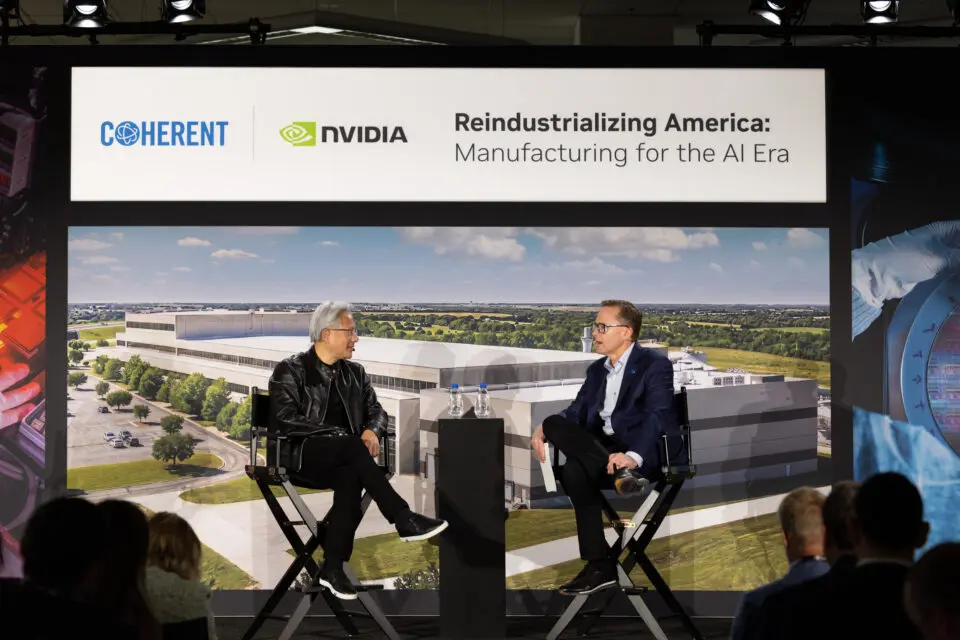
Nvidia CEO Jensen Huang called reinventing memory technologies and architectures one of the major challenges of the AI era.
Commerce Secretary Howard Lutnick framed memory as a core part of U.S. technological leadership and said Micron's commitment would strengthen domestic innovation.
Micron tied the new lab to more than 62,000 lifetime patents and separate commitments of more than $250 billion for U.S. manufacturing and R&D, with more than 90,000 jobs attached to those plans.
The Boise facility is positioned as a dedicated home for research upstream of commercial products.
The 10-year horizon makes the lab a bet that future AI systems will need architectural changes that conventional process improvements cannot deliver alone.
The Boise facility is scheduled to become Micron's long-term research base for technologies beyond today's product lines.