Infrastructure Captures 82% Of Generative AI Value As Applications Lag
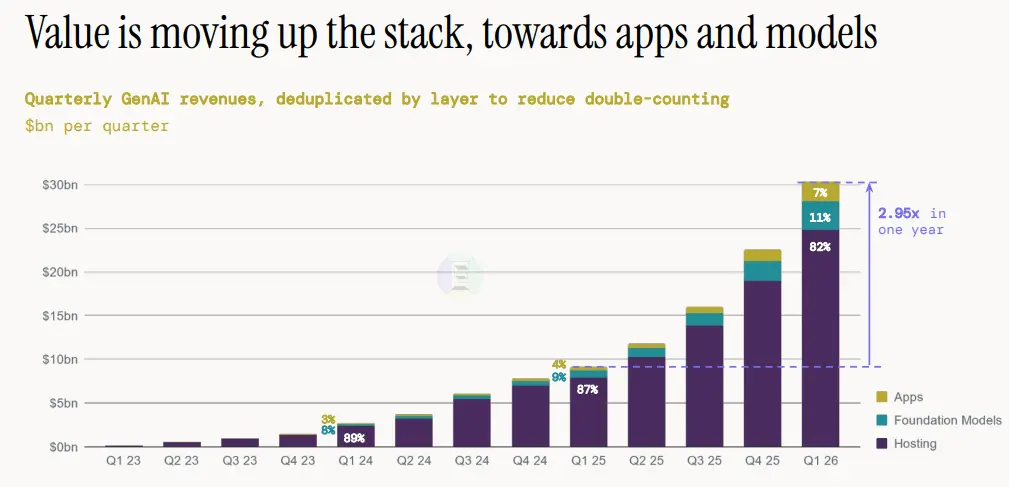
AI Times Korea cited Exponential View data showing 82% of measured AI-economy value going to cloud, GPU and inference infrastructure in Q1 2026, while foundation-model companies accounted for 11% and applications 7%.
Hosting Infrastructure Captures 82% Of AI-Economy Value
Hosting infrastructure captured 82% of the generative AI economy’s measured value in the first quarter of 2026, while foundation-model companies accounted for 11% and applications for 7%.
AI Times Korea reported the figures from Exponential View’s The State of the AI Economy 2026, which analysed how value is distributed across infrastructure, foundation-model and application layers after removing duplicate revenue across the AI stack.
The report measured $110 billion in actual generative-AI revenue over the most recent 12 months.
Its annualised revenue run rate reached $175 billion as enterprise adoption moved beyond experimentation towards productivity improvements and workflow automation.
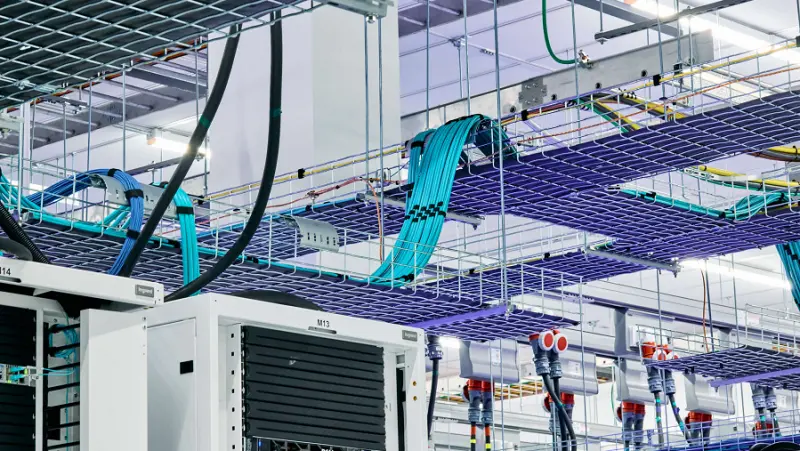
The hosting layer includes cloud services, GPUs, data centres, cloud operations and inference infrastructure.
That concentration puts companies such as Nvidia and major hyperscalers at the centre of the measured economic value, even though model developers remain the most visible businesses in the sector.
Applications Gain Ground As Models Account For 11%
The foundation-model layer, including companies such as OpenAI and Anthropic, represented 11% of captured value.
Applications accounted for the remaining 7%, up from 4% a year earlier.
The increase reflects the expansion of AI agents, coding tools and enterprise AI services built on top of foundation models.
As enterprise customers use these systems for work and workflow automation, more value is being recorded in services that connect models to specific business tasks.
The report’s layer-based figures do not map directly onto individual companies.
OpenAI and Anthropic operate across several categories through products such as ChatGPT, Claude, enterprise AI services and API platforms, so their revenue can sit across model, application and platform layers.
Valuations Still Depend On Company-Level Economics
AI Times Korea separately cited a Financial Times interpretation that questioned the long-term valuations of OpenAI and Anthropic ahead of possible initial public offerings.
Research and development, GPU purchases and cloud infrastructure costs were identified as expenses that could make durable profitability difficult to establish.
OpenAI is pursuing the Stargate project and in-house chip development to reduce infrastructure costs and increase supply-chain control.
The article also said narrower performance gaps between models could push competition towards enterprise services, agents and productivity platforms, while Google is expanding AI features to keep users inside its model ecosystem.
Neither the Exponential View report nor the Financial Times interpretation provided company-level profit, cash-flow, customer, infrastructure-spending or IPO-timing data for OpenAI or Anthropic.
The 82%, 11% and 7% figures therefore describe where value accrued across the AI industry, not the financial performance of any single company.