SendTech Times
Analysis
INFRASTRUCTURE CONSTRAINT:

Stratos Data Center Cuts Utah Plan as Water Backlash Tests AI Infrastructure Growth

Newsroom brief

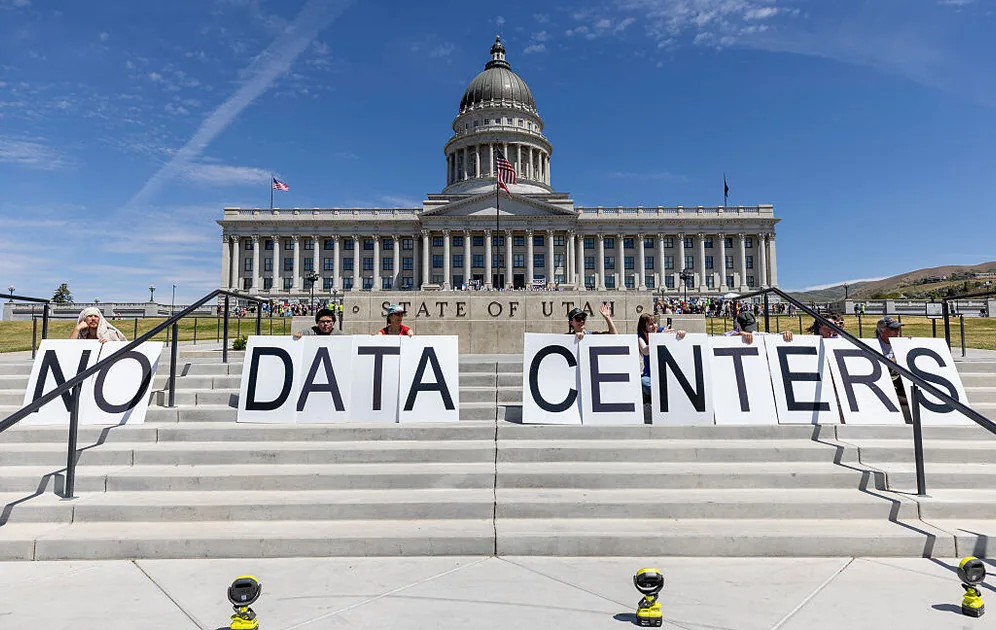
A major Utah data center proposal backed by Kevin O'Leary has been cut back after local opposition turned water use and transparency into blocking issues for one of the most visible AI infrastructure fights in the United States.
Verified against source materialEdited by SendTech Times AI & Enterprise DeskSource: Arstechnica
Stratos Data Center Cuts Utah Plan as Water Backlash Tests AI Infrastructure Growth
Image source: Ars Technica

A major Utah data center proposal backed by Kevin O'Leary has been cut back after local opposition turned water use and transparency into blocking issues for one of the most visible AI infrastructure fights in the United States.

The Stratos data center project, originally planned across multiple Utah sites and described as nearly three times the size of Manhattan, has been reduced before construction begins.

The project was initially planned for 40,000 acres and has now been scaled to about 20,000 acres.

Of the remaining land, 10,000 acres would stay undeveloped, leaving about 25 percent of the original footprint for development.

Water becomes the central constraint

The most direct trigger was local resistance in Box Elder County.

Residents objected to a proposed transfer of 1,900 acre-feet of water from a ranch to the hyperscale project, with concerns focused on local water resources and the vulnerable Great Salt Lake.

Many residents paid a $15 fee to formally register comments opposing the transfer.

That local process matters because data center growth is no longer only a power or land question.

In water-stressed regions, the ability to secure public trust and environmental approvals can decide whether an AI infrastructure project advances, shrinks, or stops.

The Stratos case shows that communities are willing to use permitting processes to challenge projects even when developers present them as major local investments.

O'Leary acknowledges the process problem

O'Leary, chair of O'Leary Digital and a Shark Tank investor, told a local ABC affiliate that the project team made mistakes by not being more transparent from the start.

He said he was not expecting the intensity of the public backlash and said the team had expected people to be excited about the investment.

At an AI gala in Washington, DC, he said he had no choice but to accept a smaller project after Utah Senate President Stuart Adams asked him to reduce the scope by 75 percent.

The compromise has not resolved the trust issue.

O'Leary said he would personally take over communications and that future plans and designs would be transparent.

But local critics remain skeptical.

Brenna Williams, involved with the Box Elder Accountability Referendum, called the agreement performance art and argued that Box Elder County remains too vulnerable for a hyperscale data center of that size.

Why this matters beyond Utah

The Utah dispute is part of a broader political risk for AI infrastructure.

At least 20 data center projects were canceled after significant public backlash in the first quarter of this year, more than double the number in the previous quarter.

Public opinion has also shifted quickly against data centers, with opposition especially visible among rural voters.

That matters for developers and cloud investors because AI capacity expansion depends on more than capital expenditure and chip supply.

Projects need water, grid access, land, tax treatment, and local acceptance.

If residents see the process as rushed or opaque, the political cost can rise quickly, even in states where officials broadly support economic development.

What to watch next

The practical question is whether Stratos can secure written commitments, permitting approvals, and environmental reviews under the smaller plan.

Another signal is whether the reported nine-gigawatt capacity changes along with the land reduction; it was not immediately clear whether that capacity target would change.

The next market signal is replication.

If more communities use water, tax incentives, and transparency demands to pressure developers, AI infrastructure growth may become a slower and more negotiated process than the current investment cycle assumes.
Share this article
inXf

Related articles

More
Data Centers Have A Climate-Risk Problem. The Map Is Uneven.
Cloud & Data Centers

Data Centers Have A Climate-Risk Problem. The Map Is Uneven.

A First Street study puts 79% of global data center capacity at elevated risk from acute climate hazards. The findings make resilience, power access and water systems part of the AI infrastructure buildout test.

Adani And Jabil Turn India’s AI Data-Center Push Into A Hardware Test
Cloud & Data Centers

Adani And Jabil Turn India’s AI Data-Center Push Into A Hardware Test

Adani Group and Jabil plan to manufacture high-density AI racks, cooling systems and power equipment in India, but their data-center hardware roadmap still lacks a definitive launch timeline.

AirTrunk Makes India a Bigger Test Case for AI Data Center Buildouts
Cloud & Data Centers

AirTrunk Makes India a Bigger Test Case for AI Data Center Buildouts

AirTrunk said it would invest $30 billion in India by 2030 to develop 5GW of new AI data center capacity. Bernstein’s forecast puts the country’s data center market at up to 8GW in 2030, compared with about 1.5GW today. The practical question is whether land, power and water availability can support the proposed buildout.

Lenovo opens Japan liquid cooling lab as AI data centers face power pressure
Cloud & Data Centers

Lenovo opens Japan liquid cooling lab as AI data centers face power pressure

Lenovo Japan opened Neptune Lab for liquid cooled AI infrastructure testing inside MC Digital Realty NRT12 data center in Chiba. The project targets rising AI power density and cooling constraints as Japan AI investment and data center electricity demand grow. The lab lets customers test servers, coolant distribution, racks, networking and monitoring before production deployments.

Data Centre Heat Effects Add Siting Risk For AI Campuses
Cloud & Data Centers

Data Centre Heat Effects Add Siting Risk For AI Campuses

Data Center Knowledge wrote that studies of large AI facilities and Phoenix-area data centres show measurable local temperature effects, adding heat impact to power, water and permitting scrutiny.

AI Compute Scarcity Is Redrawing The Infrastructure Map
AI

AI Compute Scarcity Is Redrawing The Infrastructure Map

AI infrastructure projects in India, Africa, Brazil and the UAE show how power, chip access, data location and inference demand are pushing compute beyond the traditional U.S. hyperscale cloud map.

India's 8.33 GW Data-Center Pipeline Tests AI Infrastructure Readiness
Cloud & Data Centers

India's 8.33 GW Data-Center Pipeline Tests AI Infrastructure Readiness

Knight Frank India says the country's data-center development pipeline has reached 8.33 GW, with Mumbai, Hyderabad and Chennai showing how AI demand is turning capacity, power, fibre and subsea links into strategic constraints.

First Street Puts Climate Risk Into Data Center Site Selection
Cloud & Data Centers

First Street Puts Climate Risk Into Data Center Site Selection

First Street says 79% of global data center capacity is exposed to significant acute climate hazards, adding flood, wind, wildfire, heat and water stress to AI infrastructure underwriting.

Keep Reading

More Stories

Latest
Ethereum Testnet Update Targets 200 Million-Gas BlocksCrypto/Web3Oct 6, 2026Ethereum Testnet Update Targets 200 Million-Gas BlocksEthereum developers released Prysm 7.2.1 so the Sepolia trial of Glamsterdam can test 200 million-gas blocks, more than three times the prior 60 million setting, before any main-network change.Kepler Targets 2027 Production for HBM Replacement MemoryCloud & Data CentersOct 6, 2026Kepler Targets 2027 Production for HBM Replacement MemoryEE Times reports that Kepler Computing is preparing 3D ferroelectric memory for 2027 production, promising higher capacity and bandwidth per watt while limiting reliance on advanced-node lithography.Yokogawa Opens Singapore Hub For Industrial Cyber ResilienceCapital & PolicyOct 6, 2026Yokogawa Opens Singapore Hub For Industrial Cyber ResilienceYokogawa Engineering Asia has launched a Singapore center focused on OT cyber resilience, training, response planning and recovery coordination for Southeast Asia, Oceania and Taiwan.ClickFix Attack Uses Browser Cache To Hide Malware PayloadCybersecurityOct 6, 2026ClickFix Attack Uses Browser Cache To Hide Malware PayloadMicrosoft Threat Intelligence traced a ClickFix cache-smuggling method that preloads malware into browser caches, then uses file size checks and a pasted Run command to launch later credential-theft stages.VOA Tests Six-Month Startup Buildout Before Funding DecisionsFintech & Digital PaymentsOct 6, 2026VOA Tests Six-Month Startup Buildout Before Funding DecisionsTechCabal’s interview with VOA Venture Partners founder Victoria Olayide Adesanya describes a six-month build programme that lets the firm work inside African financial-infrastructure startups before deciding whether to invest.Bitcoin Holds $86,000 As Dollar Index Hits 18-Month HighCrypto/Web3Oct 6, 2026Bitcoin Holds $86,000 As Dollar Index Hits 18-Month HighCoinDesk reported that bitcoin stayed near $86,000 while the U.S. Dollar Index reached about 102.5, with U.S. rate expectations and European political risks strengthening the dollar backdrop.Google Freezes OSS Bug Bounty Reports After AI Submission FloodCybersecurityOct 6, 2026Google Freezes OSS Bug Bounty Reports After AI Submission FloodGoogle has stopped accepting new product vulnerability reports in its OSS VRP after invalid automated submissions swamped reviewers, while older reports and some Cloud VRP routes remain open.Fleuret AI Raises €4M For Continuous AI Pentesting PlatformCybersecurityOct 6, 2026Fleuret AI Raises €4M For Continuous AI Pentesting PlatformTech.eu reported that French startup Fleuret AI raised €4 million in pre-seed funding to develop an agentic-AI platform that turns penetration testing into a continuous security process.GFT Analysis Says AI Documentation Can Cut Maintenance Work 30%Fintech & Digital PaymentsOct 6, 2026GFT Analysis Says AI Documentation Can Cut Maintenance Work 30%A GFT Technologies analysis says AI-linked software documentation can cut maintenance effort and speed developer onboarding when knowledge assets stay synchronized with code changes.Schneider Electric Lines Up $22.6 Billion PTC DealAIOct 5, 2026Schneider Electric Lines Up $22.6 Billion PTC DealSchneider Electric plans to buy PTC in a cash transaction valuing the US engineering software provider’s equity at about $22.6 billion, adding product-lifecycle software to its industrial AI push.Aggarwal Pledges Ola Electric Stake To Fund ₹1,000 Cr Rights IssueCapital & PolicyOct 5, 2026Aggarwal Pledges Ola Electric Stake To Fund ₹1,000 Cr Rights IssueOla Electric founder Bhavish Aggarwal pledged 20 Cr shares to finance his participation in a rights issue that forms part of a larger ₹1,500 Cr fundraising plan.Natrona Schools AI Review Puts Student Privacy Ahead Of Classroom Tool UseAIOct 5, 2026Natrona Schools AI Review Puts Student Privacy Ahead Of Classroom Tool UseNatrona County trustees questioned whether teacher AI tools expose student data, even as existing district rules already ban unauthorized generative AI use by students.