SpaceX And Orbital File 100,000-Satellite Plans At FCC
SpaceX and Orbital Compute have filed separate FCC plans for 100,000 satellites each, with SpaceX targeting Starlink Gen 3 broadband and Orbital proposing space-based AI data-centre capacity. The filings do not include approvals, named customers, launch cadence or final commercial timetables.
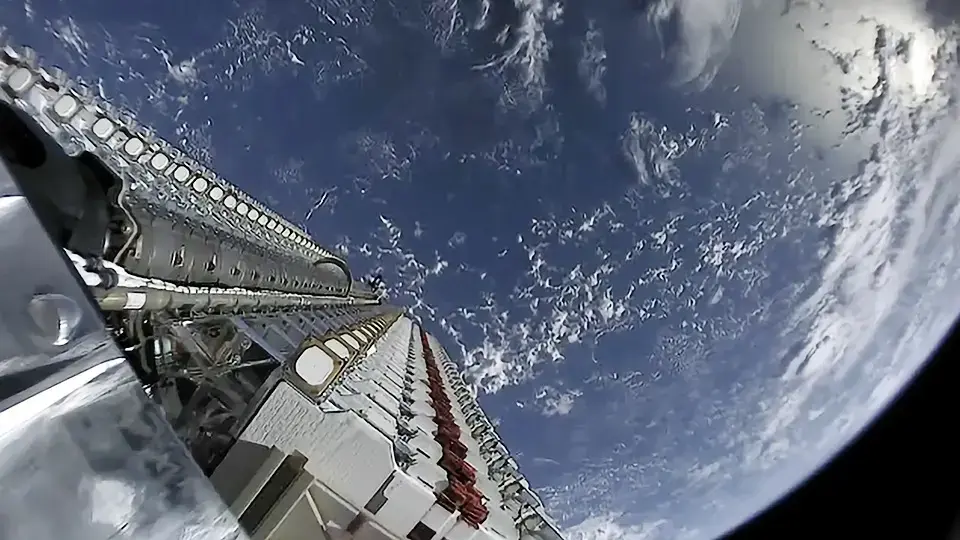
SpaceX and Orbital Compute have each filed plans with the FCC for constellations of up to 100,000 satellites, but the infrastructure goals are sharply different.
SpaceX’s application, filed Monday, expands Starlink with larger Gen 3 communications satellites.
Orbital Compute’s filing, submitted in June, proposes an orbital data-center network designed to support AI applications.
SpaceX’s Gen 3 system would sit alongside the company’s current Starlink constellation and its separate plan for up to 1 million data-center satellites.
The company said the new satellites would deliver low-latency, multi-gigabit broadband to consumers, businesses and government users, potentially extending Starlink’s role alongside terrestrial networks.
The satellites would operate between 323 and 477 kilometers above Earth, an altitude range SpaceX describes as very-low-Earth orbit.
The system would use Ku-, Ka-, V- and E-band spectrum, with anticipated use of W-band and D-band frequencies.
SpaceX also said Gen 3 could connect and support “billions of AI-powered devices around the world” and provide what it called “the communications backbone of the AI age.”
Each Gen 3 satellite is expected to weigh about 2,000 kilograms and support downstream speeds near 1 Tbit/s.
SpaceX plans to rely on Starship for deployment.
“We’re gonna need a bigger rocket! (Starship),” Elon Musk wrote on X.
Orbital Compute said its proposed constellation could eventually provide about 10 gigawatts of orbital computing power, compared with roughly 8.5 gigawatts of new electricity capacity added to the U.S. grid over the past year.
The Los Angeles startup said the system would not draw on terrestrial electricity, land or water.
Each Orbital satellite would function as a high-density rack powered by 100 kilowatts from its own solar arrays.
The company said each unit would span about 100 meters, weigh roughly two tons and use radiators to release heat into space.
Orbital plans to test a single Nvidia GPU payload on a SpaceX Falcon 9 in 2027, followed by Orbital-1, its first data-center satellite, sometime in 2028.
Founder and chief executive Euwyn Poon said in April that the company was nearing the opening of its first research and development manufacturing facility in Los Angeles.
Funding for the 2027 test is largely coming from a16z speedrun, an Andreessen Horowitz organization that says it has allocated more than $180 million to more than 150 startups.
Orbital expects each satellite to cost about $5 million, including GPUs, and plans to seek additional capital partners.
Blue Origin also has plans for orbital data centers; CNBC reported that the company was raising $10 billion at a $130 billion valuation, with Jeff Bezos intending to invest $2 billion.