Starship Flight 14 Tests Starlink V3 Satellites With 26-Tbit/s Target
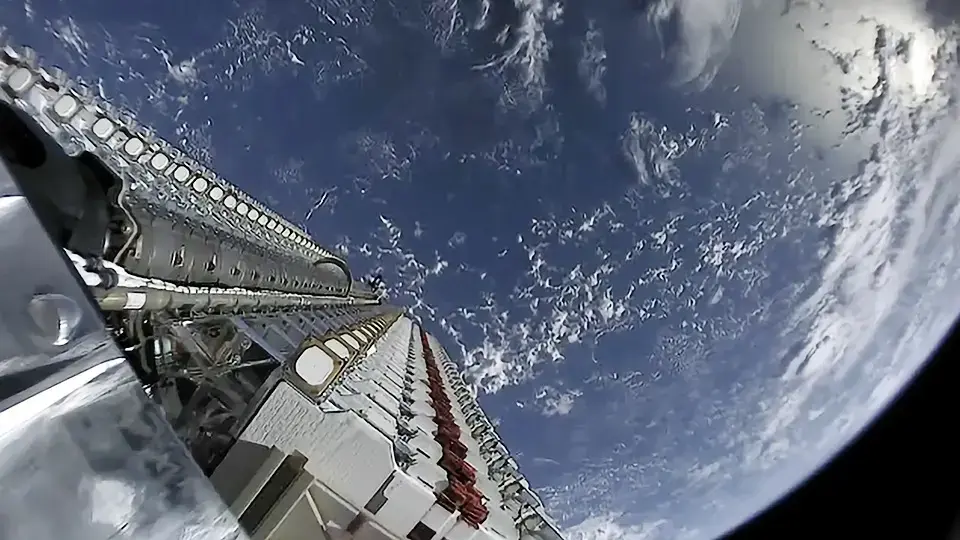
SpaceX’s planned Flight 14 would attempt to place 26 Starlink V3 satellites into orbit, adding about 26 Tbit/s of capacity while testing Starship’s first upper-stage orbital mission.

SpaceX’s next Starship flight could carry 26 high-capacity V3 satellites into orbit as early as September 28, according to Light Reading, moving the test programme toward adding usable Starlink capacity.
The flight would follow a July Starship test that released 20 V3 satellites into suborbital paths for speed checks before they burned up roughly 20 minutes later in Earth’s atmosphere.
Those trial spacecraft extended solar arrays and antennas and communicated with ground systems, but they did not join the operational Starlink constellation.
Flight 14 is designed to change that sequence.
If regulatory review clears the launch and the mission succeeds, the 26 V3 satellites would enter orbit and begin service rather than only demonstrate deployment from Starship.
This would be the first orbital service test for the new Starlink generation.
The capacity figures give the mission its broadband significance.
One V3 satellite is described as carrying roughly 1 Tbit/s of downlink and 160 Gbit/s of uplink capability.
SpaceX says that represents a 10x downlink improvement and a 22x uplink improvement over the Starlink V2 satellite.
The planned batch would add about 26 Tbit/s of total capacity if all of the spacecraft reach their intended orbital role.
That satellite step is tied to the rocket test itself.
SpaceX’s plan calls for Starship’s upper stage to reach orbit for the first time, fly about 275 kilometers above Earth, complete six orbits over nearly 10 hours, and then make a controlled reentry with splashdown in the Pacific Ocean west of Chile.
The booster is expected to perform a landing burn over the Gulf of Mexico after hardware and software modifications made since earlier tests.
Evercore ISI analysts characterized the flight as the moment when Starship could start contributing broadband capacity instead of serving only as a vehicle demonstration.
In their view, successful orbital insertion and V3 deployment would provide an early proof point for the next Starlink capacity ramp and for broader connectivity plans built around Starship.
The V3 design also affects SpaceX’s mobile plans.
Analysts cited by Light Reading expect the technology to support Gen 2 satellites for Starlink Mobile and a next-generation direct-to-device service that would use spectrum SpaceX acquired from EchoStar.
The report describes a larger-scale V3 rollout as a way to serve more users and extend access in some denser areas.
Analysts still view the service as best suited to low-density markets.
Starship’s reuse target remains the second part of the deployment story.
Elon Musk said SpaceX could try to catch the upper ship stage with tower arms during test 15 if Flight 14 succeeds, and he gave the first attempt a 50% to 60% chance of success.
SpaceX has already re-flown the booster portion of Starship, while a combined booster-and-ship reflight is targeted for the end of this year or, more likely, early 2027.
Future missions expand the same vehicle path beyond Starlink broadband.
The source lists moon and Mars missions among Starship’s later uses, along with “Starmind” AI data centre satellites.
SpaceX President Gwynne Shotwell said launches of orbital compute satellites remain on track sometime in 2027.