OpenAI Adds Usage Analytics And Spend Controls For ChatGPT Work
OpenAI said GPT-5.6 uses 54% fewer output tokens and 57% less time per task in a named coding-agent index, while its enterprise guidance tells ChatGPT Work admins to manage AI spend by accepted outcomes, usage analytics and governance controls rather than token price alone.
OpenAI states that GPT-5.6 uses 54% fewer output tokens and 57% less time per task in the Artificial Analysis Coding Agent Index, but the company’s new enterprise guidance shifts the cost discussion toward accepted outcomes, admin controls and repeatable workflows.
The official post notes that token prices fell 97% from GPT-4 to GPT-5.4.
It argues that token price alone is not enough to measure AI value, because enterprises still need to track tasks completed, time saved, decisions improved and workflows ready to scale.
GPT-5.6 Metrics Sit Beside Enterprise Spend Controls
The guidance frames enterprise AI cost around useful work per dollar rather than the lowest price per token.
Cheaper models can still add cost when they fail, retry or produce work that needs correction, according to OpenAI.
For priority workflows, customers are advised to track cost per accepted outcome.
The examples are a resolved customer-support case or a tested engineering change that passes review.
OpenAI adds that teams should evaluate the full cost of reaching a quality bar, including model and tool usage, attempts, completion rate, latency and human review.
The post recommends cutting repeated model calls by narrowing instructions, limiting tools, reusing context and setting clear stop conditions.
ChatGPT Work Admin Console Tracks Usage By User, Product And Model
ChatGPT Work supports longer, multi-step tasks, so usage can vary widely by workflow.
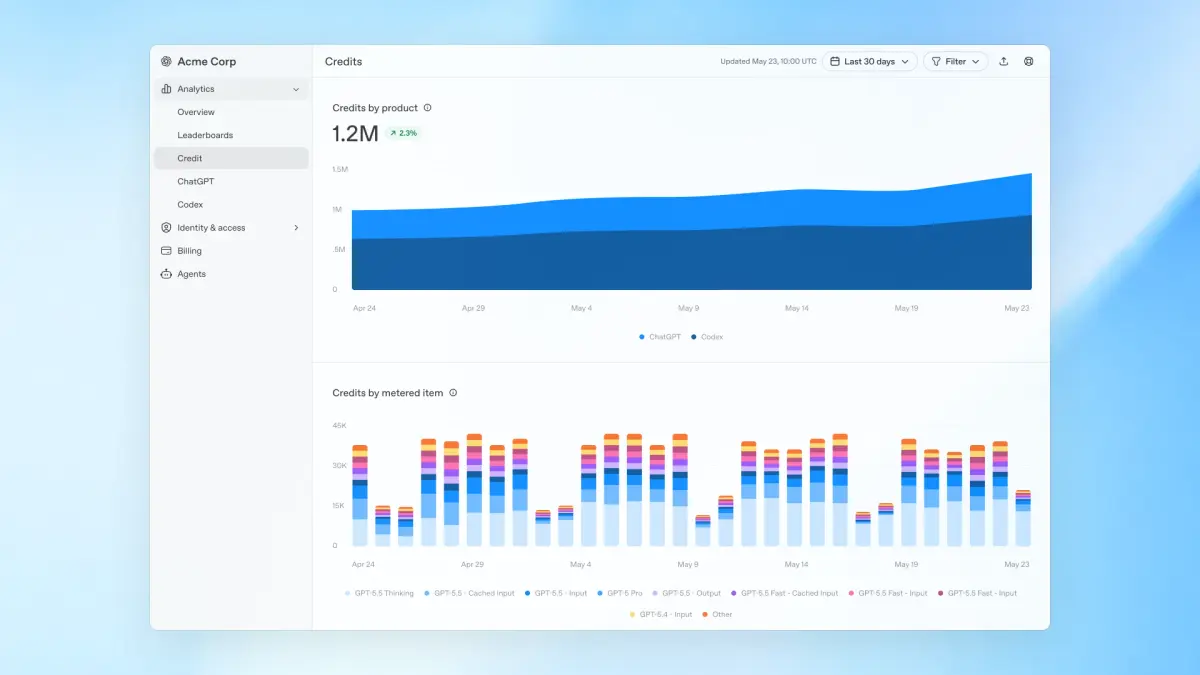
The Admin Console provides administrators with usage analytics and spend controls covering adoption, credit usage and spend by user, product and model.
Workspace, team, user, product and model views can show whether adoption and spending are moving together, where demand is growing and whether higher-cost models are being used for sustained work.
These controls act as a management layer for ChatGPT Work, not as proof that every AI workflow has a demonstrated return.
The same guidance separates experimentation from production funding, with representative validation before larger deployments.
Governance Controls Cover Tools, Context And Approvals
The governance section indicates that scaling depends on approved ChatGPT context, available tools, permitted actions, higher-risk approvals and the process for granting extra capacity.
Those settings are linked to broader use of plugins, connectors, Computer Use and frontier tools that can act across enterprise systems.
ChatGPT Work gives administrators controls for access, approved context, connected tools, permitted actions, usage and spend.
Spend-control options include default workspace settings, group caps, individual exceptions and project-context review requests.
OpenAI notes that AI Deployment Engineers can work with customers on evals, architecture, latency, reliability and workflow design for priority deployments.
Customer Savings And Deployment Counts Remain Outside The Public Record
The investment section describes a portfolio of broad productivity access, function-specific workflows and strategic bets built around proprietary company context.
Production funding should cover integrations, controls, reliability and change management once a workflow passes exploration and validation.
The post describes OpenAI Frontier and Deployment Company as support for enterprise AI coworker projects across internal systems.
ChatGPT Work covers chat, coding, agentic workflows, connectors, plugins, Computer Use and administration.
Customer-level savings, deployment counts, ChatGPT Work pricing changes and independent third-party validation of the GPT-5.6 efficiency figures remain outside the public record.