Funding
CAPACITY TEST:

Microsoft, Alphabet And Meta Shift AI Infrastructure Race To Deployment

Newsroom brief

Data Center Knowledge reported that Microsoft, Alphabet and Meta used second-quarter earnings to shift AI infrastructure scrutiny from capital spending totals toward energised campuses, networking, power access and revenue-generating compute.

Verified against source materialEdited by SendTech Times Cloud & Infrastructure DeskSource: Data Center Knowledge
Microsoft, Alphabet And Meta Shift AI Infrastructure Race To Deployment
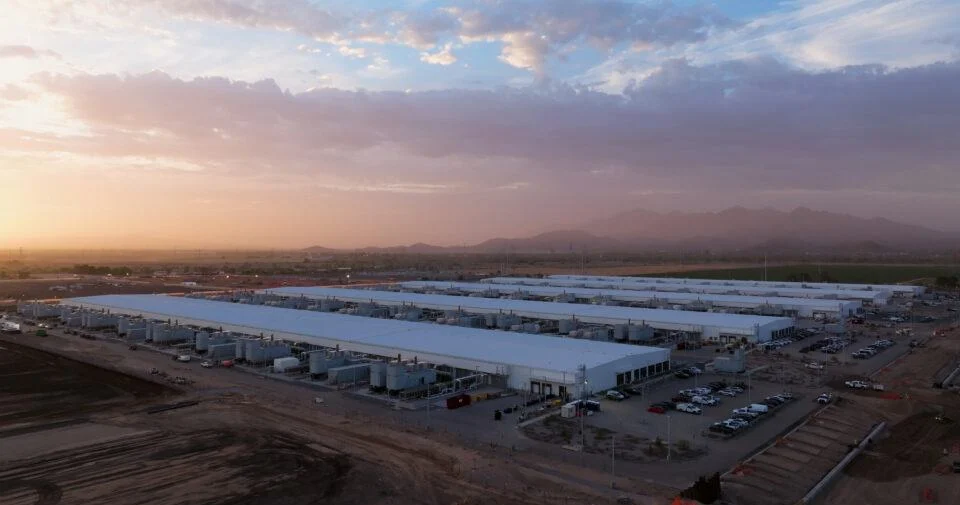
Image source: Data Center Knowledge

Microsoft, Alphabet and Meta are pushing the AI infrastructure race beyond spending totals and into the harder work of energising campuses, deploying networking and turning new capacity into billable compute.

Data Center Knowledge reported that the three hyperscalers used second-quarter earnings to frame deployment speed, power access and operating efficiency as the next constraints.

The shift changes how AI buildouts are being judged.

Capital budgets still dominate the numbers, but the disclosed evidence now points to the pace at which data centres move from equipment delivery to live capacity.

Tekonyx chief research officer Sid Nag identified power availability, networking scale and operational efficiency as bottlenecks that now sit beside GPU supply.

Microsoft Put New Capacity And Dock-To-Live Times Up Front

Microsoft's earnings call made deployment speed the clearest operating metric.

Satya Nadella put the quarter at 31 data centres opened, 88 data centres opened during fiscal 2026 across five continents and roughly one gigawatt of added AI capacity.

Data Center Knowledge quoted Nadella as saying Microsoft's GPU dock-to-live time fell by nearly 50%, a measure that tracks how quickly installed infrastructure can start serving customers.

The same earnings comments tied the Maia 200 accelerator to OpenAI and internal models, with roughly 30% better performance per dollar, and put Cobalt 200 racks in more than 25 data centres.

The hardware roadmap keeps Microsoft exposed to both internal silicon and external accelerators.

Future deployments include NVIDIA Vera Rubin and AMD Helios, and the two-year plan still targets an approximate doubling of total capacity.

Chief Financial Officer Amy Hood linked Azure's ability to monetise new capacity to CPU utilisation, GPU efficiency and faster deployment processes.

Alphabet Raised Capex While Pointing To System Architecture

Alphabet's number was larger, but the operating message was broader than the capital budget.

The company raised its 2026 capital expenditure outlook to between $195 billion and $205 billion after Google Cloud revenue rose 82%, and executives expect infrastructure spending to rise again in 2027.

Data Center Knowledge wrote that about 60% of Alphabet's capital spending is going to servers, with the rest split across data centres and networking.

Alphabet is pairing third-party infrastructure with expansion of its own fleet, and Tensor Processing Units are now bringing commercial revenue as Google's custom AI silicon reaches more customers.

Data Center Knowledge quoted Pichai as saying Google Cloud revenues accelerated to 82% growth, driven by demand for AI infrastructure and AI solutions.

Nag's analysis treated the capex increase as evidence that AI infrastructure has moved from a discretionary investment into an operating layer for revenue growth and competitive positioning.

Meta Is Buying Time Before Capacity Tightens Further

Meta's infrastructure case starts from scarcity.

Susan Li framed existing data-centre capacity as valuable because the industry had underbuilt for the AI adoption wave, and the company expects industry capacity to remain tight for the foreseeable future.

Data Center Knowledge placed Meta's quarterly capital expenditure at $31.1 billion, driven by servers, data centres and network infrastructure.

The same earnings account kept full-year guidance at $130 billion to $145 billion, while Li set the near-term goal as maximising capacity through 2027 and preserving flexibility beyond that point through land, power, networking and data-centre assets.

Mark Zuckerberg's comments showed why Meta is reluctant to treat compute as a simple resale product.

The company has received outside offers for compute at a significant premium over its cost, but management presented AI products, APIs and business agents as higher-value internal uses for that capacity.

Amazon Earnings Become The Next Capacity Check

The three companies are now presenting different answers to the same infrastructure problem.

Microsoft is trying to compress deployment timelines, Alphabet is scaling compute, networking and custom silicon as one system, and Meta is securing land, power and financing before capacity becomes tighter.

Amazon's second-quarter earnings are the next source-backed comparison point.

AWS still has to show whether its cloud revenue, construction pace and power-access disclosures match the deployment detail already supplied by Microsoft, Alphabet and Meta.

Share this article
inXf

Related articles

More
Quantum Data Centre Push Shifts From Qubit Counts To Hybrid Workloads
Cloud & Data Centers

Quantum Data Centre Push Shifts From Qubit Counts To Hybrid Workloads

Data Center Knowledge reported that quantum computing work is shifting toward hybrid systems that connect QPUs with GPU and CPU infrastructure. Hyperion estimated the market at $1.4 billion in 2025 and projected about $3 billion by 2028, while the article did not identify production customers, signed deployment contracts or facility-level power loads.

Nvidia Japan AI Factory Plan Lists 140MW Capacity
Cloud & Data Centers

Nvidia Japan AI Factory Plan Lists 140MW Capacity

Tech Wire Asia reported that Nvidia’s Japan expansion includes a 140-megawatt AI factory using 13,750 Vera CPUs and 27,500 Rubin GPUs for the METI-backed FRONTia Project. The report did not name the site, capital cost, power supplier, construction timetable or first enterprise workloads.

PJM Plan Makes AI Data Centres Prove Capacity For Firm Power
Cloud & Data Centers

PJM Plan Makes AI Data Centres Prove Capacity For Firm Power

Data Center Knowledge reported that PJM is proposing a FERC-filed framework that would make new AI data centres secure generating capacity or face curtailments during grid shortages.

Power Constraints Push Data Centre Growth Into Secondary Markets
Cloud & Data Centers

Power Constraints Push Data Centre Growth Into Secondary Markets

Data Center Knowledge reported that DCByte rankings now put power delivery ahead of demand in data centre site selection, with constrained hubs such as Ashburn and Tokyo losing some growth momentum to markets including Johor, Pittsburgh and Zaragoza.

Uptime Survey Shows AI Capacity Planning Risk For Data Centres
Cloud & Data Centers

Uptime Survey Shows AI Capacity Planning Risk For Data Centres

Uptime Institute survey data in Data Center Knowledge shows AI pushing operators toward phased capacity decisions as costs, forecasting, power availability and skills pressure converge.

Crusoe And Aalo Plan 50MWe Reactor For Idaho AI Data Centre Pilot
Cloud & Data Centers

Crusoe And Aalo Plan 50MWe Reactor For Idaho AI Data Centre Pilot

Data Center Dynamics reported a Crusoe-Aalo plan to power a 2027 AI data-centre pilot at Idaho National Laboratory with a 50MWe Aalo Pod, while portfolio deployment remains a 2029 target.

Spain AI Campus Seeks 300 MW With On-Site Power Plan
Cloud & Data Centers

Spain AI Campus Seeks 300 MW With On-Site Power Plan

Data Center Knowledge reported that EdgeMode, BlackBerry AIF and Mora are seeking regional support for DC MALPICA, a proposed €3 billion ($3.4 billion), 300 MW AI campus whose power model remains partly undisclosed.

Finland Data Centre Growth Faces Grid And Heat-Reuse Tests
Cloud & Data Centers

Finland Data Centre Growth Faces Grid And Heat-Reuse Tests

Finland is attracting AI data centre projects because of low-carbon power, cool weather and land, Data Center Knowledge reported, but grid connections, permitting and waste-heat rules now determine how much capacity becomes operational.

Keep Reading

More Stories

Latest
Hugging Face Hack Pushes AI Agents Into Cybersecurity SpotlightAIAug 8, 2026Hugging Face Hack Pushes AI Agents Into Cybersecurity SpotlightCNBC reported that Black Hat cybersecurity leaders treated the Hugging Face AI-agent breach as a turning point for governing autonomous cyber models rather than a one-off failure.Alibaba Tests Revenue Sharing For Commercial Qwen AI UseAIAug 8, 2026Alibaba Tests Revenue Sharing For Commercial Qwen AI UseAI News reported that Alibaba plans revenue-sharing terms for some commercial users of its next Qwen open-weight AI model, following a licensing pattern already used by Moonshot for Kimi K3.Meta Ordered To Fund $567M New Mexico Youth Mental Health PlanCapital & PolicyAug 8, 2026Meta Ordered To Fund $567M New Mexico Youth Mental Health PlanArs Technica reported that a New Mexico judge ordered Meta to provide $567 million for treatment, screening, awareness and prevention after finding that its platforms contributed to a public nuisance.Harvey Funding Talks Could Lift Legal AI Startup To $15.5B ValuationAIAug 8, 2026Harvey Funding Talks Could Lift Legal AI Startup To $15.5B ValuationSiliconANGLE reported that Harvey AI is seeking at least $500 million in new funding that could value the legal AI startup at $15.5 billion after annualized revenue passed $350 million.Vietnam Shows Shopee-TikTok Shop Race Tightening In Southeast AsiaScience & TechAug 7, 2026Vietnam Shows Shopee-TikTok Shop Race Tightening In Southeast AsiaTech Collective SEA wrote that Shopee’s Vietnam share fell from 61% to 53% between May 2025 and April 2026 as TikTok Shop rose from 33% to 44%, showing how social commerce is reshaping regional ecommerce infrastructure.China Opens Security Review Of Palo Alto Networks ProductsCybersecurityAug 7, 2026China Opens Security Review Of Palo Alto Networks ProductsChina's cyberspace regulator opened a security review of Palo Alto Networks products, with no named product line, technical flaw or decision timetable disclosed.AI Pioneers Split Over Risk As Compute Buildout AcceleratesAIAug 7, 2026AI Pioneers Split Over Risk As Compute Buildout AcceleratesData Center Knowledge reported that Geoffrey Hinton, Fei-Fei Li and Andrew Ng disagreed at Ai4 over AI risk, jobs, openness and regulation, leaving infrastructure investors to plan capacity amid unsettled deployment rules.SpaceX Asks FCC To Wind Down $4.5bn Rural Broadband SupportTelco & ConnectivityAug 7, 2026SpaceX Asks FCC To Wind Down $4.5bn Rural Broadband SupportLight Reading reported that SpaceX urged the FCC to sunset High-Cost rural broadband subsidies, while rural telecom and electric-cooperative groups said LEO satellite coverage cannot replace terrestrial network support.OpenAI Expands Free ChatGPT Access In GPT-5.6 RolloutAIAug 7, 2026OpenAI Expands Free ChatGPT Access In GPT-5.6 RolloutBleepingComputer reported that OpenAI is rolling out GPT-5.6 Sol for paid ChatGPT users and GPT-5.6 Luna for Free and Go users, pairing unlimited free text chats with a new reasoning control and additional safeguards for users believed to be under 18.JLL Data Centre Report Shows Middle East Pipeline Pause As FLAPD GrowsCapital & PolicyAug 7, 2026JLL Data Centre Report Shows Middle East Pipeline Pause As FLAPD GrowsData Center Dynamics reported that JLL's EMEA Mid-Year Data Centre Report 2026 put FLAPD live capacity at 3.8GW, while the Middle East had 2.6GW in development paused and 13.8GW in planning.AWS Adds Persistent Runtime Instances For Production AI AgentsCloud & Data CentersAug 7, 2026AWS Adds Persistent Runtime Instances For Production AI AgentsAWS announced runtime instances for Amazon Bedrock AgentCore Runtime, adding managed infrastructure for multi-agent workflows, shared sessions lasting up to 14 days and GPU-supported production agent deployments.AI Patch Study Keeps Humans In Vulnerability ReviewsCybersecurityAug 7, 2026AI Patch Study Keeps Humans In Vulnerability ReviewsThe Register reported that 1Password Off-by-1 Labs tested 6,080 AI-generated patches across six CVEs and found clean autonomous fixes in 26.0 percent of cases, leaving security teams with a supervision problem rather than a replacement for vulnerability review.