SendTech Times
News
SYSTEMS SHIFT:

Kaspersky Flags AI And Password Risks For Malaysian Firms

Newsroom brief

Kaspersky cited Malaysian AI use, weak passwords and hybrid work as workplace cybersecurity risks after recording higher 2025 spyware and backdoor detections. Named victim companies, incident costs and confirmed breaches tied to AI-themed lures remain outside the public record.

Verified against source materialEdited by SendTech Times Cybersecurity DeskSource: Tech Wire Asia
Kaspersky Flags AI And Password Risks For Malaysian Firms
Image source: Tech Wire Asia

Malaysian businesses are facing a broader workplace cybersecurity exposure as employees use AI tools, personal devices and shared online services across office and home settings.

Kaspersky linked those habits to weak passwords, compromised accounts, unsecured services and rising detections of spyware, backdoors and software disguised as AI products.

Everyday tools widen workplace exposure

Kaspersky’s findings show how deeply AI has entered daily workflows in Malaysia.

Among Malaysian respondents who had used AI tools, 87% said they used them to search for information.

Another 63% used AI for work-related tasks, including preparing reports, presentations, data analysis and generating ideas.

More than one-third also used AI for personal activities such as studying, entertainment, travel planning and other daily tasks.

The overlap matters because employees increasingly use the same devices, accounts, applications and online services for personal and professional purposes.

Only 57% of Malaysian respondents said they had enabled two-factor authentication, while 44% continued to use easy-to-remember passwords.

Another 40% said they used password generators.

A study cited by Kaspersky from the Malaysian Employers Federation found that more than 70% of companies in Malaysia had adopted hybrid working models, leaving employees to access company systems from offices, homes and other locations.

Malaysia detections rose in 2025

Kaspersky’s threat intelligence data recorded 194,692 spyware attacks targeting organisations in Malaysia in 2025, a 75% increase from the previous year.

Spyware can collect sensitive information.

The company also detected and blocked 212,239 backdoor attacks against Malaysian businesses during the same period, up 86% year on year.

Backdoors allow attackers to maintain unauthorised access to compromised systems.

These figures are vendor detections, rather than a count of named companies or confirmed national breaches.

Fake AI services target SMBs

Kaspersky detected more than 92,000 malware and potentially unwanted application attacks worldwide between January and early May 2026 that were disguised as AI services.

Fake ChatGPT accounted for nearly half of those detections.

Malwarebytes reported in May 2026 that a fake ChatGPT download site imitated OpenAI’s desktop app page and delivered malware to Windows and macOS users.

The reported payloads included credential-stealing malware and a macOS stealer.

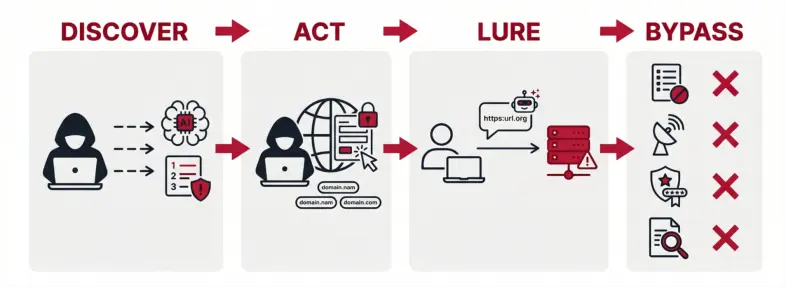
The FBI has also warned that cybercriminals use redirection systems to send users to fake login pages, phishing sites and malware-laced software updates.

The US Federal Trade Commission advises users to avoid unfamiliar websites when downloading free content because of malware exposure risks.

The threat was especially visible in small and medium-sized businesses.

From January to April 2026, Kaspersky’s security solutions detected more than 33,300 global SMB attacks in which malicious or unwanted PC software was disguised as popular AI services—almost five times the figure from the same period in 2025.

ChatGPT, Claude and DeepSeek were the most common AI-themed lures, accounting for 42%, 24% and 20% of detections, respectively.

In Southeast Asia, Kaspersky recorded more than 1,800 SMB attacks involving software disguised as AI services during the same period, nearly seven times higher year on year.

Micro, small and medium-sized enterprises account for 97.2% to 99.9% of establishments across ASEAN member states.

Many of the malicious files targeting SMBs were Trojware, which is designed to appear harmless but can download additional malware or steal, delete, block, modify or copy data from compromised devices.

Kaspersky also blocked almost 415,000 attacks involving software disguised as Telegram, WhatsApp, Zoom and Microsoft Teams from January to April 2026.

That figure changed only marginally from the previous year.

Adrian Hia, Managing Director for Asia Pacific at Kaspersky, said employee behaviour remains part of organisational cybersecurity risk.

“Businesses can deploy sophisticated security strategies and solutions, but the reality is that employees do not leave their digital habits at the office door,” Hia said.

“The same behaviours that guide how people interact with technology in their personal lives can also carry over into the workplace.”

Share this article
inXf

Related articles

More
Socket Tracks 108 Malicious Packages In PolinRider Supply-Chain Attack
Cybersecurity

Socket Tracks 108 Malicious Packages In PolinRider Supply-Chain Attack

Socket reported 162 malicious release artefacts across 108 packages in the PolinRider supply-chain campaign. Victim companies remain outside the public record.

Target-Locked Malware Narrows Central Asia Cyber Espionage Risk
Cybersecurity

Target-Locked Malware Narrows Central Asia Cyber Espionage Risk

Backend News reported, citing Kaspersky, that a campaign active since January 2025 used custom malware, OctLurk and SilkLurk backdoors, and PlugX to target public-sector, healthcare and research bodies in Central Asia and Syria.

CISA Tightens GitHub Controls After May AWS Key Leak
Cybersecurity

CISA Tightens GitHub Controls After May AWS Key Leak

CISA said privileged AWS GovCloud keys from a contractor appeared in a public GitHub repository in May, prompting secret rotation, repository monitoring and new incident playbooks. Logs showed no customer or mission data exposure, while the contractor, repository, exposure window and exact AWS permissions remain outside the public account.

MovieReaper Malware Spreads Through Compromised Torrent Repository
Cybersecurity

MovieReaper Malware Spreads Through Compromised Torrent Repository

Kaspersky traced MovieReaper infections to a compromised public torrent-file repository that let attackers distribute malicious movie-themed downloads across multiple tracker sites.

TrueConf Server Flaws Expose Client Installers To Backdoors
Cybersecurity

TrueConf Server Flaws Expose Client Installers To Backdoors

BleepingComputer reported that unpatched TrueConf servers are being abused to deliver backdoored client installers, with Kaspersky linking the activity to Head Mare and fixed server branches now available.

Unit 42 Finds 13,229 Malicious URLs In AI Phantom-Domain Study
Cybersecurity

Unit 42 Finds 13,229 Malicious URLs In AI Phantom-Domain Study

Palo Alto Networks’ Unit 42 said its phantom-squatting research generated 685,339 prompts across 913 brands and produced 2.1 million unique URLs, including 13,229 malicious URLs and about 250,000 unique phantom domains. The public report did not disclose the brand list, affected customer names or named domains tied to data loss.

MacSync Malware Hides Mac Payload Delivery In An iCloud Calendar
Cybersecurity

MacSync Malware Hides Mac Payload Delivery In An iCloud Calendar

Kaspersky researchers found a new MacSync variant using a fake crypto wallet app, executable payloads and an iCloud calendar handoff to steal Mac credentials, wallet data and files.

Microsoft Revokes 11 Secure Boot Shims After ESET Finds Bypass Risk
Cybersecurity

Microsoft Revokes 11 Secure Boot Shims After ESET Finds Bypass Risk

Ars Technica reported that ESET found 11 old UEFI shim images that Microsoft still trusted even after known defects. Microsoft revoked the shims in its June patch release, while the reason the lapse lasted for years remains outside the public account.

Keep Reading

More Stories

Latest
Ethereum Testnet Update Targets 200 Million-Gas BlocksCrypto/Web3Oct 6, 2026Ethereum Testnet Update Targets 200 Million-Gas BlocksEthereum developers released Prysm 7.2.1 so the Sepolia trial of Glamsterdam can test 200 million-gas blocks, more than three times the prior 60 million setting, before any main-network change.Kepler Targets 2027 Production for HBM Replacement MemoryCloud & Data CentersOct 6, 2026Kepler Targets 2027 Production for HBM Replacement MemoryEE Times reports that Kepler Computing is preparing 3D ferroelectric memory for 2027 production, promising higher capacity and bandwidth per watt while limiting reliance on advanced-node lithography.Yokogawa Opens Singapore Hub For Industrial Cyber ResilienceCapital & PolicyOct 6, 2026Yokogawa Opens Singapore Hub For Industrial Cyber ResilienceYokogawa Engineering Asia has launched a Singapore center focused on OT cyber resilience, training, response planning and recovery coordination for Southeast Asia, Oceania and Taiwan.ClickFix Attack Uses Browser Cache To Hide Malware PayloadCybersecurityOct 6, 2026ClickFix Attack Uses Browser Cache To Hide Malware PayloadMicrosoft Threat Intelligence traced a ClickFix cache-smuggling method that preloads malware into browser caches, then uses file size checks and a pasted Run command to launch later credential-theft stages.VOA Tests Six-Month Startup Buildout Before Funding DecisionsFintech & Digital PaymentsOct 6, 2026VOA Tests Six-Month Startup Buildout Before Funding DecisionsTechCabal’s interview with VOA Venture Partners founder Victoria Olayide Adesanya describes a six-month build programme that lets the firm work inside African financial-infrastructure startups before deciding whether to invest.Bitcoin Holds $86,000 As Dollar Index Hits 18-Month HighCrypto/Web3Oct 6, 2026Bitcoin Holds $86,000 As Dollar Index Hits 18-Month HighCoinDesk reported that bitcoin stayed near $86,000 while the U.S. Dollar Index reached about 102.5, with U.S. rate expectations and European political risks strengthening the dollar backdrop.Google Freezes OSS Bug Bounty Reports After AI Submission FloodCybersecurityOct 6, 2026Google Freezes OSS Bug Bounty Reports After AI Submission FloodGoogle has stopped accepting new product vulnerability reports in its OSS VRP after invalid automated submissions swamped reviewers, while older reports and some Cloud VRP routes remain open.Fleuret AI Raises €4M For Continuous AI Pentesting PlatformCybersecurityOct 6, 2026Fleuret AI Raises €4M For Continuous AI Pentesting PlatformTech.eu reported that French startup Fleuret AI raised €4 million in pre-seed funding to develop an agentic-AI platform that turns penetration testing into a continuous security process.GFT Analysis Says AI Documentation Can Cut Maintenance Work 30%Fintech & Digital PaymentsOct 6, 2026GFT Analysis Says AI Documentation Can Cut Maintenance Work 30%A GFT Technologies analysis says AI-linked software documentation can cut maintenance effort and speed developer onboarding when knowledge assets stay synchronized with code changes.Schneider Electric Lines Up $22.6 Billion PTC DealAIOct 5, 2026Schneider Electric Lines Up $22.6 Billion PTC DealSchneider Electric plans to buy PTC in a cash transaction valuing the US engineering software provider’s equity at about $22.6 billion, adding product-lifecycle software to its industrial AI push.Aggarwal Pledges Ola Electric Stake To Fund ₹1,000 Cr Rights IssueCapital & PolicyOct 5, 2026Aggarwal Pledges Ola Electric Stake To Fund ₹1,000 Cr Rights IssueOla Electric founder Bhavish Aggarwal pledged 20 Cr shares to finance his participation in a rights issue that forms part of a larger ₹1,500 Cr fundraising plan.Natrona Schools AI Review Puts Student Privacy Ahead Of Classroom Tool UseAIOct 5, 2026Natrona Schools AI Review Puts Student Privacy Ahead Of Classroom Tool UseNatrona County trustees questioned whether teacher AI tools expose student data, even as existing district rules already ban unauthorized generative AI use by students.