SendTech Times
Analysis
SYSTEMS SHIFT:

Instacart’s Grocery AI Rollout Tests Whether Agents Can Build Baskets Without Breaking Trust

Newsroom brief

Instacart has rolled out an AI shopping assistant to millions of U.S. customers, with U.S. and Canada expansion planned in the coming months. The assistant turns prompts, photos and deal requests into carts using live inventory from nearly 100,000 stores and data from more than 1.6 billion lifetime orders. The tension is whether larger baskets and personalization can scale while customers still review every decision before checkout.
Verified against source materialEdited by SendTech Times AI & Enterprise DeskSource: Instacart
Instacart’s Grocery AI Rollout Tests Whether Agents Can Build Baskets Without Breaking Trust
Image source: Instacart

Instacart is moving agentic commerce from a partner-platform promise into its own grocery marketplace, rolling out an AI assistant that can turn a meal idea, shopping prompt or uploaded list into a ready-to-review cart.

Instacart Turns Grocery Search Into Cart Building

The assistant is now available to millions of U.S. customers through Instacart’s app and website.

A full rollout across the U.S. and Canada is planned in the coming months, after months of testing.

The product is built for a specific retail problem: grocery recommendations fail quickly when items are out of stock, household preferences are ignored or substitutions feel random.

Instacart says the assistant uses grocery-specific machine learning, live inventory and customer history to build baskets that reflect what is available at a chosen retailer.

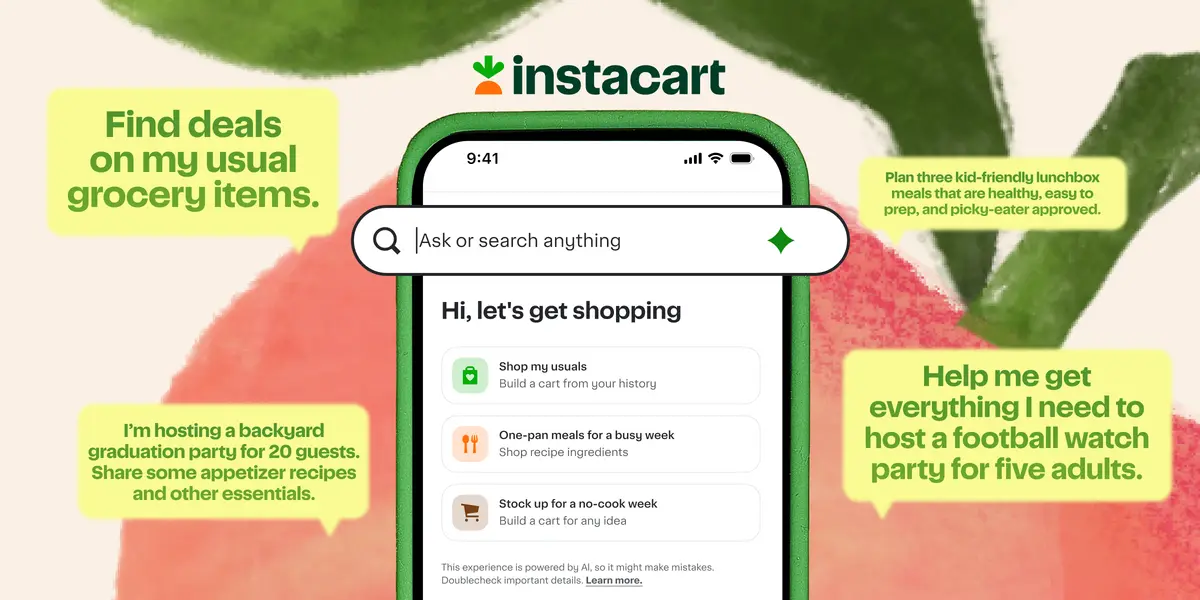
Users can ask for easy weeknight dinners, deals on usual items, a party menu or a cart based on a handwritten list.

The assistant can generate meal ideas with shoppable ingredient lists, translate a list photo into items, surface promotions and adapt suggestions to brand preferences and dietary choices.

The Data Claim Is The Competitive Moat

Instacart’s case rests on the depth of its grocery data.

The company says the assistant draws on more than 1.6 billion lifetime orders and live inventory from nearly 100,000 stores across North America.

It also points to signals from household behavior, millions of consumers and thousands of retail banners.

Those figures matter because agentic shopping is only useful if the agent understands availability, substitutions, recurring purchases and price sensitivity.

A general chatbot can suggest dinner; a grocery agent has to convert that suggestion into an in-stock basket that a household is willing to buy.

Instacart also frames the assistant as part of a wider AI strategy for retailers and advertisers.

The same grocery intelligence is being extended through enterprise tools, Storefront Pro, ads optimization tools and integrations with ChatGPT, Claude and Gemini.

Early Usage Points To A Basket-Size Bet

The company says early testing showed customers using the assistant for more complex tasks such as recipe discovery and meal planning, not only faster search.

Orders placed with the AI assistant are, on average, larger than Instacart’s typical basket, while the platform’s average order value is $113.

Survey data included with the launch explains the demand side of the bet.

An Instacart-commissioned Harris Poll of more than 2,000 U.S. adults found that 83% say deciding what to make for dinner causes stress.

The same survey found more than two in three would be interested in an AI-powered assistant for that task, while just 8% currently use AI for meal planning or grocery shopping.

The commercial question is whether higher-value baskets come from genuine convenience or from nudging customers toward more items.

Instacart says the tool does not finalize anything without explicit action and that every decision is reviewed before checkout.

That review step is important if agentic shopping is to feel like help rather than automated upselling.

Rollout Risk Is About Trust, Not Only Accuracy

Grocery is a difficult test case for consumer AI because mistakes are personal and immediate.

A wrong size, missing ingredient, unsuitable brand or unavailable item can make the whole basket less useful.

That is why Instacart’s strongest claim is not simply that the assistant can generate carts in seconds.

The bigger test is whether it can keep improving from customer accepts, refinements and rejections while preserving user control.

If customers trust the assistant enough to use it for weekly planning, agentic commerce moves closer to a repeat habit.

If they feel the cart needs too much correction, the feature becomes another search layer with a conversational interface.

Share this article
inXf

Related articles

More
Visa And Mastercard Push Tokens Into The Trust Layer For AI Shopping
Fintech & Digital Payments

Visa And Mastercard Push Tokens Into The Trust Layer For AI Shopping

Visa and Mastercard are building agentic-commerce payment frameworks around tokenized credentials, authenticated agents and permissioned transactions. Consumer data shows 45% comfort with AI agents completing purchases, but 95% still have at least one concern, making trust and fraud protection the real adoption test.

DoorDash Tests AI Ordering With Prompts, Photos And Reservation Search
AI

DoorDash Tests AI Ordering With Prompts, Photos And Reservation Search

DoorDash is rolling out Ask DoorDash, an AI chatbot that can build grocery carts from prompts, photos or recipes and help users search restaurants and reservations on iOS in select regions.

HP Moves OpenAI Frontier From Pilots To Enterprise Workflows Without ROI Data
AI

HP Moves OpenAI Frontier From Pilots To Enterprise Workflows Without ROI Data

HP is scaling an OpenAI Frontier partnership across support, security, device and software workflows after pilots, while the public record still lacks pricing, deployment dates or measured return on investment.

Upstage Turns Daum Into The Distribution Layer For Solar AI Agents
AI

Upstage Turns Daum Into The Distribution Layer For Solar AI Agents

South Korea’s Upstage is tying its Solar models to Daum search, Timelee agents and a planned Loom desktop agent as it moves from model development toward search, enterprise and consumer AI services.

Sakana Marlin Tests Whether AI Agents Can Handle Strategy Research, Not Just Chat
AI

Sakana Marlin Tests Whether AI Agents Can Handle Strategy Research, Not Just Chat

Sakana AI has launched Sakana Marlin as an enterprise research agent that can spend up to 8 hours preparing a 100-page strategy report, while the public record still lacks customer evidence or details on data handling.

Airbnb’s Chesky Tests Whether AI Needs Its Own Interface Lab
AI

Airbnb’s Chesky Tests Whether AI Needs Its Own Interface Lab

Brian Chesky is preparing to support a separate AI research effort centered on interface design while keeping his Airbnb CEO role. Airbnb’s AI markers include 40% customer-support automation, conversational search built around a large language model, and a planned voice assistant later this year. The central question is whether a founder-led lab can turn interface research into useful consumer AI without a disclosed team, funding amount or timeline.

Poke Gets Apple Approval as AI Agents Move Into iMessage Distribution
AI

Poke Gets Apple Approval as AI Agents Move Into iMessage Distribution

Poke received approval to operate on Apple's Messages for Business platform, adding iMessage to its AI-agent distribution channels. The startup says it has relayed about 100 million messages and will pay Apple on a per-user basis, with exact pricing not disclosed. The immediate test is whether iMessage access increases consumer use enough to justify the new platform cost.

Hunar.AI Tests Voice Agents On India’s Frontline Hiring Gap
AI

Hunar.AI Tests Voice Agents On India’s Frontline Hiring Gap

Bengaluru-based Hunar.AI says its voice agents now handle more than 5 Lakh calls a day for frontline hiring, onboarding and retention workflows, with customers including Swiggy, Zepto, Croma and Starbucks.

Keep Reading

More Stories

Latest
Kepler Targets 2027 Production for HBM Replacement MemoryCloud & Data CentersOct 6, 2026Kepler Targets 2027 Production for HBM Replacement MemoryEE Times reports that Kepler Computing is preparing 3D ferroelectric memory for 2027 production, promising higher capacity and bandwidth per watt while limiting reliance on advanced-node lithography.Yokogawa Opens Singapore Hub For Industrial Cyber ResilienceCapital & PolicyOct 6, 2026Yokogawa Opens Singapore Hub For Industrial Cyber ResilienceYokogawa Engineering Asia has launched a Singapore center focused on OT cyber resilience, training, response planning and recovery coordination for Southeast Asia, Oceania and Taiwan.ClickFix Attack Uses Browser Cache To Hide Malware PayloadCybersecurityOct 6, 2026ClickFix Attack Uses Browser Cache To Hide Malware PayloadMicrosoft Threat Intelligence traced a ClickFix cache-smuggling method that preloads malware into browser caches, then uses file size checks and a pasted Run command to launch later credential-theft stages.VOA Tests Six-Month Startup Buildout Before Funding DecisionsFintech & Digital PaymentsOct 6, 2026VOA Tests Six-Month Startup Buildout Before Funding DecisionsTechCabal’s interview with VOA Venture Partners founder Victoria Olayide Adesanya describes a six-month build programme that lets the firm work inside African financial-infrastructure startups before deciding whether to invest.Bitcoin Holds $86,000 As Dollar Index Hits 18-Month HighCrypto/Web3Oct 6, 2026Bitcoin Holds $86,000 As Dollar Index Hits 18-Month HighCoinDesk reported that bitcoin stayed near $86,000 while the U.S. Dollar Index reached about 102.5, with U.S. rate expectations and European political risks strengthening the dollar backdrop.Google Freezes OSS Bug Bounty Reports After AI Submission FloodCybersecurityOct 6, 2026Google Freezes OSS Bug Bounty Reports After AI Submission FloodGoogle has stopped accepting new product vulnerability reports in its OSS VRP after invalid automated submissions swamped reviewers, while older reports and some Cloud VRP routes remain open.Fleuret AI Raises €4M For Continuous AI Pentesting PlatformCybersecurityOct 6, 2026Fleuret AI Raises €4M For Continuous AI Pentesting PlatformTech.eu reported that French startup Fleuret AI raised €4 million in pre-seed funding to develop an agentic-AI platform that turns penetration testing into a continuous security process.GFT Analysis Says AI Documentation Can Cut Maintenance Work 30%Fintech & Digital PaymentsOct 6, 2026GFT Analysis Says AI Documentation Can Cut Maintenance Work 30%A GFT Technologies analysis says AI-linked software documentation can cut maintenance effort and speed developer onboarding when knowledge assets stay synchronized with code changes.Schneider Electric Lines Up $22.6 Billion PTC DealAIOct 5, 2026Schneider Electric Lines Up $22.6 Billion PTC DealSchneider Electric plans to buy PTC in a cash transaction valuing the US engineering software provider’s equity at about $22.6 billion, adding product-lifecycle software to its industrial AI push.Aggarwal Pledges Ola Electric Stake To Fund ₹1,000 Cr Rights IssueCapital & PolicyOct 5, 2026Aggarwal Pledges Ola Electric Stake To Fund ₹1,000 Cr Rights IssueOla Electric founder Bhavish Aggarwal pledged 20 Cr shares to finance his participation in a rights issue that forms part of a larger ₹1,500 Cr fundraising plan.Natrona Schools AI Review Puts Student Privacy Ahead Of Classroom Tool UseAIOct 5, 2026Natrona Schools AI Review Puts Student Privacy Ahead Of Classroom Tool UseNatrona County trustees questioned whether teacher AI tools expose student data, even as existing district rules already ban unauthorized generative AI use by students.AMD Prices 256-Core EPYC 9996 At $14,904 For Server BuyersChips & SemiconductorsOct 5, 2026AMD Prices 256-Core EPYC 9996 At $14,904 For Server BuyersTechRadar reports that AMD’s 6th Gen EPYC 9006 “Venice” lineup includes a 256-core EPYC 9996 with 512 threads, 1GB of L3 cache, a 600W default power rating and a $14,904 list price for 1,000-unit orders.