Infineon Opens €5 Billion Dresden Fab Three Months Early Without Customer Names
Infineon Technologies opened its €5 billion Module 4 smart power fab in Dresden three months ahead of schedule. Customers, order volumes or utilisation targets remain outside the public record.
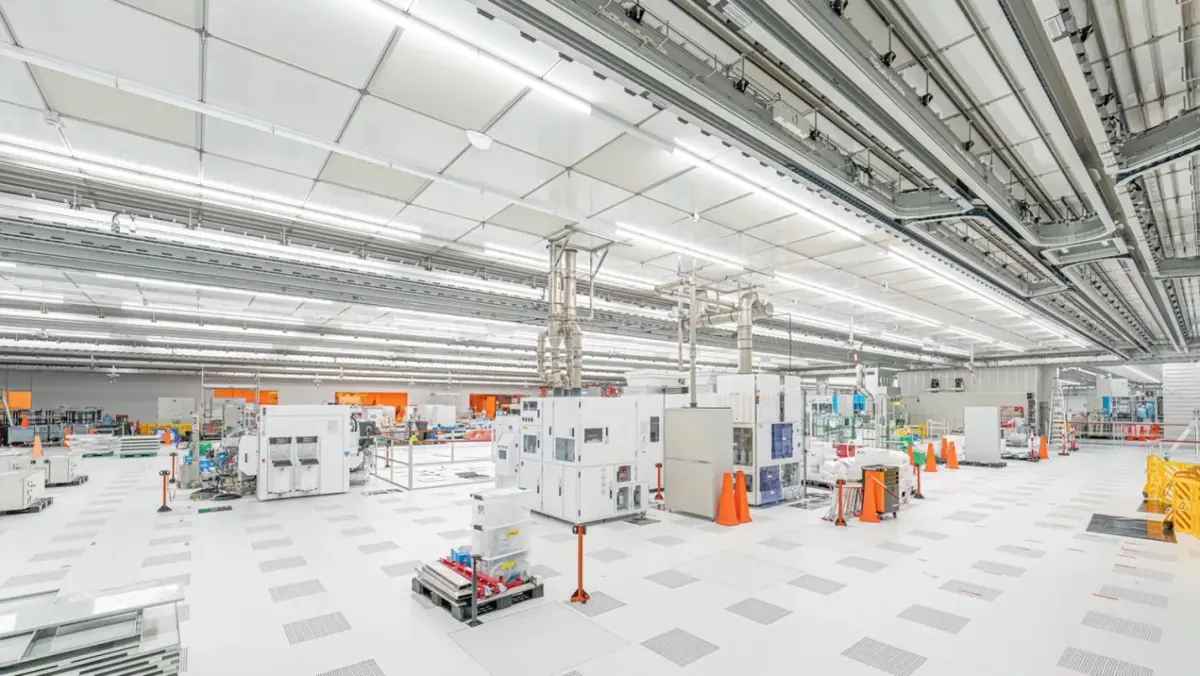
Infineon Technologies has opened its €5 billion Module 4 smart power fab in Dresden three months ahead of schedule, turning a project that broke ground in May 2023 into the company’s largest facility for intelligent power semiconductor systems.
The 300-mm fab formally opened on July 2 and is larger than comparable Infineon sites in Asia and the United States.
The speed of the launch was a central focus of the opening.
Alexander Gorski, Infineon’s chief operations officer, said the company used a “one virtual fab” model linking its manufacturing sites in Villach, Austria; Kulim, Malaysia; and Dresden, Germany.
The facilities have been standardized around the same tools, processes and software, while real-time digital twins mirror operations across the network.
That common structure allows Infineon to transfer experience from existing equipment to identical systems in a new facility.
Gorski said the approach enables the company to qualify complex equipment more quickly and ramp capacity twice as fast as it did in the past.
The Dresden plant is designed to add capacity for power semiconductors and analog/mixed-signal devices.
Its output will range from standard power switches such as MOSFETs to complex analog/mixed-signal power-management ICs and highly intricate SoCs for humanoid robotics.
Infineon is using the site as part of a global manufacturing network rather than treating Dresden as a self-contained supply chain.
The company operates front-end and back-end facilities and uses a hybrid outsourcing strategy that varies by product.
Gorski said a higher proportion of control and connectivity products is outsourced than analog and sensing products or power devices.
Infineon CEO Jochen Hanebeck said the new capacity is intended to support energy supply for AI data centers, software-defined vehicles and renewable-energy systems.
When fully loaded, Gorski said, the fab will contribute about €5 billion, or roughly $5.7 billion, in additional revenue.
German officials presented the opening as an industrial milestone for the country and Europe.
Chancellor Friedrich Merz addressed about 400 people from the Silicon Saxony ecosystem by video.
Saxony Minister-President Michael Kretschmer said the project demonstrated that major industrial developments could be implemented securely and swiftly when the necessary conditions were in place.
Module 4 therefore combines a large capital investment with a manufacturing model built around shared processes, digital twins and coordinated capacity across Europe and Asia.
Its stated role is to supply power and mixed-signal technologies for data centers, vehicles, renewable-energy systems and emerging robotics applications.