IBM Study Finds UAE AI Vendor Switching Risk
Middle East AI News, citing IBM Institute for Business Value data, said 88 per cent of surveyed UAE executives would struggle to switch their primary AI vendor or model, while 96 per cent did not fully understand dependencies across vendors, models and infrastructure.
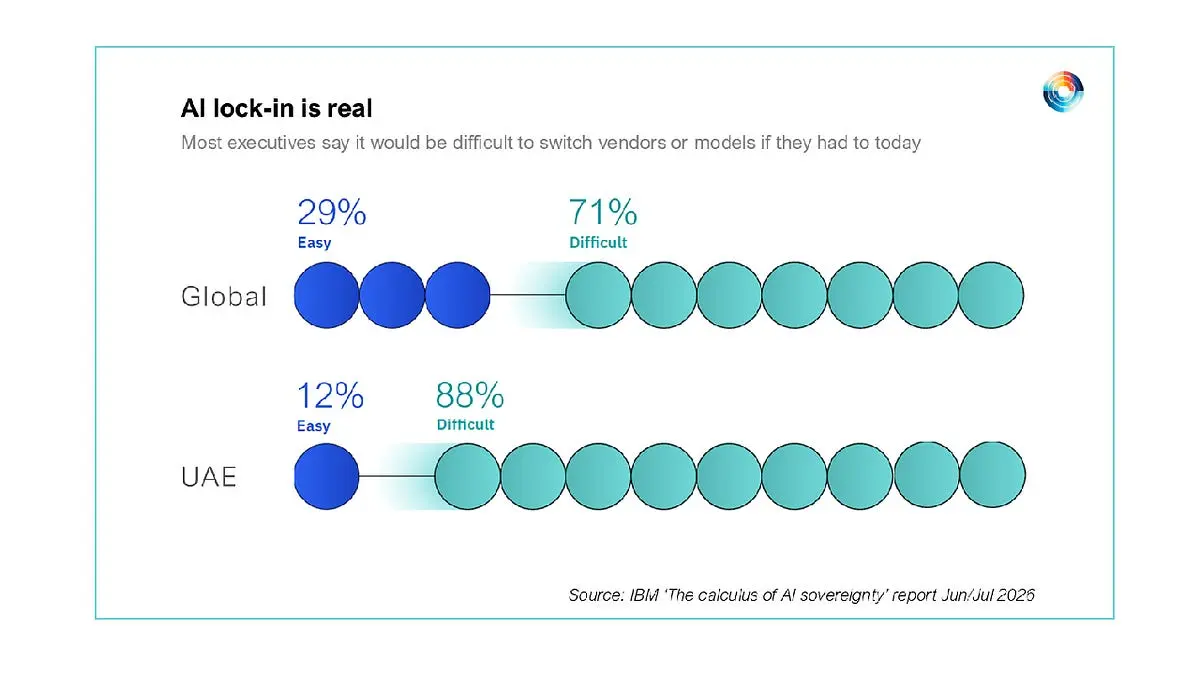
Eighty-eight percent of surveyed UAE executives would struggle to switch their primary AI vendor or model, while 96% did not fully understand dependencies across vendors, models and infrastructure.
Middle East AI News reported the IBM Institute for Business Value findings, which put vendor choice alongside data residency, migration planning and outage resilience as an operating risk.
IBM Survey Sets UAE Above Global Switching Baselines
The IBM Institute for Business Value study covered 1,000 senior executives across 16 countries and 17 industries and was run with Oxford Economics between February and April 2026.
The UAE sample sat above the global baseline on switching difficulty.
Middle East AI News cited IBM data putting the UAE figure at 88 per cent, compared with a 71 per cent global average.
Data residency added another control layer.
The cited IBM study put the UAE share of respondents who considered data residency and sovereignty requirements across geographies challenging at 74 per cent, compared with 68 per cent globally.
Multivendor AI Still Leaves Migration Friction
Multivendor adoption has not removed the lock-in risk.
IBM's cited UAE data put multivendor use at 82 per cent, above the 73 per cent global figure, yet 80 per cent of UAE executives still expected a core AI system move to a new vendor to take at least six months.
The migration burden also extends to data movement.
UAE executives estimated an average of 150 days to move AI training and operational data to a different environment, according to the cited study.
That timing links vendor choice to continuity planning.
If a model, cloud environment or infrastructure provider becomes unavailable, a nominally multivendor strategy may still leave teams waiting on data transfer, compliance checks and application retesting before critical AI workflows can move.
Outage Exposure Raises The Governance Stakes
The UAE sample also showed higher disruption exposure.
The cited IBM study recorded an average of seven AI-related disruptions for UAE organisations over the past two years, compared with six globally, and put severe-disruption expectations for a week-long vendor outage at 84 per cent among UAE respondents.
Cost tolerance points to the same control pressure.
UAE executives appeared willing to pay more for flexibility, which places vendor exit rights, data portability and dependency mapping in the same risk conversation as model performance or contract price.
IBM's global maturity finding gives the governance issue a financial edge.
The cited study put operating-profit protection at 55 per cent higher for organisations with the most advanced AI control capabilities, while only 7 per cent of surveyed organisations currently reached that level.
For UAE technology and risk teams, the study points to a governance problem rather than a simple vendor-selection issue.
AI contracts, data architecture and model approval rules need to be designed for exit paths before a vendor disruption forces one.