News
MARKET SIGNAL:

Fake GitHub Repositories Turned Developer Trust Into BoryptGrab Delivery Chain

Newsroom brief

DeveloperTech's article on Arctic Wolf Labs research describes a fake-repository campaign that used polished GitHub project pages as a delivery route for BoryptGrab malware. The case makes artifact provenance and workstation controls more important than visual trust in repository pages.

Verified against source materialEdited by SendTech Times Cybersecurity DeskSource: DeveloperTech / Arctic Wolf Labs
Fake GitHub Repositories Turned Developer Trust Into BoryptGrab Delivery Chain

Fake GitHub project pages gave BoryptGrab operators a delivery route into developer workflows by pairing familiar repository branding on the GitHub Pages platform with off-site downloads.

In DeveloperTech's account of Arctic Wolf Labs research, the campaign began on June 26 and covered at least 292 impersonation repositories.

The Arctic Wolf Labs analysis also found seventy-eight related redirectors still active during the investigation.

Fake Repositories Created A Trust Surface

The copied pages imitated software companies, security vendors, developer tools, cryptocurrency services and other technology brands.

README material, marketing language, organisation names and download buttons made the repositories resemble ordinary vendor or project destinations.

One page used an organisation named “Arctic-Wolf-Security” and displayed a fabricated onboarding checklist with an “OFFICIAL PAGE” button.

Search-engine placement widened exposure for users who reached the pages through software searches instead of verified vendor websites.

The risk sat in the gap between a repository page that looked legitimate and the separate party controlling the download behind it.

For developers, the page itself was weak evidence of who built the executable or where the archive came from.

Redirects Separated The Page From The Payload

A download click moved visitors from a GitHub Pages address to an external distribution domain.

The destination carried the brand name from the original repository, leaving the visible repository and downloaded archive as separate parts of the chain.

The investigation treated generated binaries as the weak point because they were detached from the source code shown in the repositories.

Download pages displayed trust labels including “VirusTotal Approved,” “Secure Archive” and “Verified Access”; DeveloperTech's article did not treat those labels as proof that the named services had inspected the files.

Template code handled the brand-matching work by pulling a brand name from the URL and inserting it into the page heading, subtitle and browser title.

URL identifiers also let the operator track which repository or redirector produced a download.

Rotating Archives Led To DLL Side-Loading

DeveloperTech's article said the server generated a new malicious ZIP archive approximately every 60 seconds.

The archive name and executable name changed to match the impersonated software brand.

Arctic Wolf Labs recovered two malicious libcurl.dll samples and treated their hashes as part of a rotating set, rather than fixed indicators.

The archive examined in the research contained a legitimate, digitally signed WinGUP updater, a malicious libcurl.dll file and extra files added to increase size.

The renamed updater loaded the malicious DLL from the same folder through DLL side-loading.

Its signature covered the legitimate executable, leaving the archive contents as the control point for defenders.

Arctic Wolf Labs said the campaign sample shared 94% of its functions with a previously documented BoryptGrab reference binary.

BoryptGrab Shifted The Issue To Workstation Controls

BoryptGrab's collection scope moved the story from repository abuse to endpoint policy.

Arctic Wolf Labs listed 11 theft modules targeting browser credentials, cookies, messaging applications, gaming accounts, Windows Credential Manager, cryptocurrency wallets and files stored in Desktop and Documents folders.

The research also covered process-level access to credentials protected by Chrome's App-Bound Encryption.

The collected information was placed in a ZIP archive and sent to a hardcoded command-and-control server.

Arctic Wolf Labs assessed the campaign as financially motivated without a named threat-group attribution.

For software teams, the defensive consequence is a workstation-control problem as much as a source-control problem.

Repository age, branding and documentation have to be checked against vendor-owned links, final download destinations, signed releases, provenance attestations and executable-use policies before developer machines run code from a page that only appears trusted.

Because the public account does not identify every impersonated brand or the number of users who downloaded the rotating archives, exposure assessment has to start with endpoint logs and artifact provenance rather than repository appearance alone.


Share this article
inXf

Related articles

More
Arch Linux Freezes AUR Package Adoption After Malware Takeovers
Cybersecurity

Arch Linux Freezes AUR Package Adoption After Malware Takeovers

Arch Linux temporarily blocked AUR package adoption after malicious package takeovers, shifting the immediate security problem from package removal to maintainer-account review and developer secret exposure.

SourTrade Malvertising Makes Browsers Assemble Windows Malware
Cybersecurity

SourTrade Malvertising Makes Browsers Assemble Windows Malware

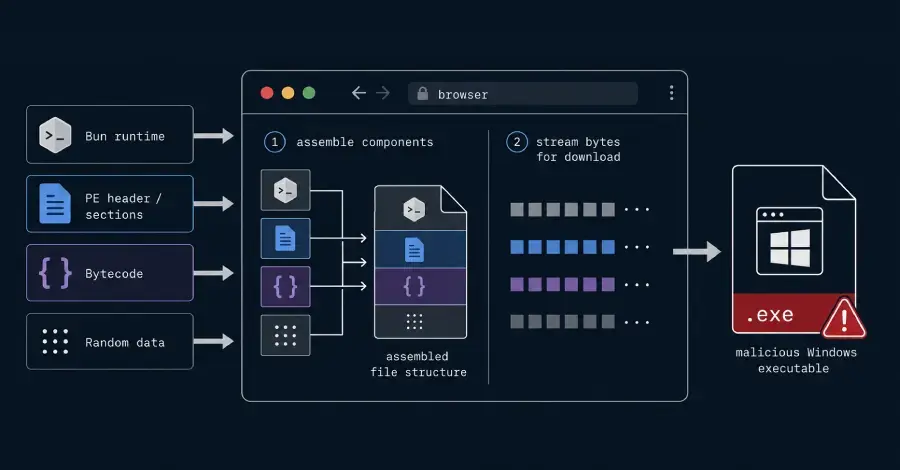
The Hacker News reported that Confiant analysed SourTrade, a malvertising campaign that uses fake trading pages and browser-side assembly to vary Windows malware files for retail trading and crypto targets.

Target-Locked Malware Narrows Central Asia Cyber Espionage Risk
Cybersecurity

Target-Locked Malware Narrows Central Asia Cyber Espionage Risk

Backend News reported, citing Kaspersky, that a campaign active since January 2025 used custom malware, OctLurk and SilkLurk backdoors, and PlugX to target public-sector, healthcare and research bodies in Central Asia and Syria.

Google AI Workflow Pushes Chrome Security Fixes To 1,072 Bugs
Cybersecurity

Google AI Workflow Pushes Chrome Security Fixes To 1,072 Bugs

BleepingComputer reported that Google attributed 1,072 Chrome security bug fixes to Chrome 149 and Chrome 150, while faster patch delivery remains part of the browser security plan.

Anthropic Mythos Finds Crypto Flaws Without Real-World Impact
Cybersecurity

Anthropic Mythos Finds Crypto Flaws Without Real-World Impact

CyberScoop reported that Anthropic used Claude Mythos Preview to find weaknesses in HAWK and a reduced AES test, while Anthropic stressed that current software remains unaffected.

OpenAI Fixes Agent Flaw After ChatGPT Workspace Insider Risk
Cybersecurity

OpenAI Fixes Agent Flaw After ChatGPT Workspace Insider Risk

SecurityWeek reported that OpenAI fixed the AgentForger flaw in ChatGPT Workspace Agents after Zenity Labs showed how a phishing link could create a hidden autonomous agent with access to already-authorised connectors.

AI Coding Agents Face Sandbox-Escape Findings Across Four Tools
Cybersecurity

AI Coding Agents Face Sandbox-Escape Findings Across Four Tools

BleepingComputer reported that Pillar Security reproduced sandbox-escape paths in Cursor, OpenAI Codex, Gemini CLI and Google Antigravity, shifting attention from agent containment to trusted developer tools around the workspace.

Neo Raises $100M To Control Enterprise AI Software Actions
Cybersecurity

Neo Raises $100M To Control Enterprise AI Software Actions

SecurityWeek reported that Neo emerged from stealth with $100 million for a platform that governs AI agents, MCP servers and software actions across enterprise systems.

Keep Reading

More Stories

Latest
Hugging Face Hack Pushes AI Agents Into Cybersecurity SpotlightAIAug 8, 2026Hugging Face Hack Pushes AI Agents Into Cybersecurity SpotlightCNBC reported that Black Hat cybersecurity leaders treated the Hugging Face AI-agent breach as a turning point for governing autonomous cyber models rather than a one-off failure.Alibaba Tests Revenue Sharing For Commercial Qwen AI UseAIAug 8, 2026Alibaba Tests Revenue Sharing For Commercial Qwen AI UseAI News reported that Alibaba plans revenue-sharing terms for some commercial users of its next Qwen open-weight AI model, following a licensing pattern already used by Moonshot for Kimi K3.Meta Ordered To Fund $567M New Mexico Youth Mental Health PlanCapital & PolicyAug 8, 2026Meta Ordered To Fund $567M New Mexico Youth Mental Health PlanArs Technica reported that a New Mexico judge ordered Meta to provide $567 million for treatment, screening, awareness and prevention after finding that its platforms contributed to a public nuisance.Harvey Funding Talks Could Lift Legal AI Startup To $15.5B ValuationAIAug 8, 2026Harvey Funding Talks Could Lift Legal AI Startup To $15.5B ValuationSiliconANGLE reported that Harvey AI is seeking at least $500 million in new funding that could value the legal AI startup at $15.5 billion after annualized revenue passed $350 million.Vietnam Shows Shopee-TikTok Shop Race Tightening In Southeast AsiaScience & TechAug 7, 2026Vietnam Shows Shopee-TikTok Shop Race Tightening In Southeast AsiaTech Collective SEA wrote that Shopee’s Vietnam share fell from 61% to 53% between May 2025 and April 2026 as TikTok Shop rose from 33% to 44%, showing how social commerce is reshaping regional ecommerce infrastructure.China Opens Security Review Of Palo Alto Networks ProductsCybersecurityAug 7, 2026China Opens Security Review Of Palo Alto Networks ProductsChina's cyberspace regulator opened a security review of Palo Alto Networks products, with no named product line, technical flaw or decision timetable disclosed.AI Pioneers Split Over Risk As Compute Buildout AcceleratesAIAug 7, 2026AI Pioneers Split Over Risk As Compute Buildout AcceleratesData Center Knowledge reported that Geoffrey Hinton, Fei-Fei Li and Andrew Ng disagreed at Ai4 over AI risk, jobs, openness and regulation, leaving infrastructure investors to plan capacity amid unsettled deployment rules.SpaceX Asks FCC To Wind Down $4.5bn Rural Broadband SupportTelco & ConnectivityAug 7, 2026SpaceX Asks FCC To Wind Down $4.5bn Rural Broadband SupportLight Reading reported that SpaceX urged the FCC to sunset High-Cost rural broadband subsidies, while rural telecom and electric-cooperative groups said LEO satellite coverage cannot replace terrestrial network support.OpenAI Expands Free ChatGPT Access In GPT-5.6 RolloutAIAug 7, 2026OpenAI Expands Free ChatGPT Access In GPT-5.6 RolloutBleepingComputer reported that OpenAI is rolling out GPT-5.6 Sol for paid ChatGPT users and GPT-5.6 Luna for Free and Go users, pairing unlimited free text chats with a new reasoning control and additional safeguards for users believed to be under 18.JLL Data Centre Report Shows Middle East Pipeline Pause As FLAPD GrowsCapital & PolicyAug 7, 2026JLL Data Centre Report Shows Middle East Pipeline Pause As FLAPD GrowsData Center Dynamics reported that JLL's EMEA Mid-Year Data Centre Report 2026 put FLAPD live capacity at 3.8GW, while the Middle East had 2.6GW in development paused and 13.8GW in planning.AWS Adds Persistent Runtime Instances For Production AI AgentsCloud & Data CentersAug 7, 2026AWS Adds Persistent Runtime Instances For Production AI AgentsAWS announced runtime instances for Amazon Bedrock AgentCore Runtime, adding managed infrastructure for multi-agent workflows, shared sessions lasting up to 14 days and GPU-supported production agent deployments.AI Patch Study Keeps Humans In Vulnerability ReviewsCybersecurityAug 7, 2026AI Patch Study Keeps Humans In Vulnerability ReviewsThe Register reported that 1Password Off-by-1 Labs tested 6,080 AI-generated patches across six CVEs and found clean autonomous fixes in 26.0 percent of cases, leaving security teams with a supervision problem rather than a replacement for vulnerability review.