
SendTech Times
News
MARKET SIGNAL:

SourTrade Malvertising Makes Browsers Assemble Windows Malware

Newsroom brief

The Hacker News reported that Confiant analysed SourTrade, a malvertising campaign that uses fake trading pages and browser-side assembly to vary Windows malware files for retail trading and crypto targets.
Verified against source materialEdited by SendTech Times Cybersecurity DeskSource: The Hacker News
SourTrade Malvertising Makes Browsers Assemble Windows Malware
Image source: The Hacker News

A malvertising campaign is using the browser as the assembly point for Windows malware, reducing the value of simple file-hash blocking without removing the need for network-level detection.

The Hacker News reported that Confiant analysed the SourTrade operation, which targets retail traders and cryptocurrency investors through fake trading-service pages.

Confiant's July 23 analysis said the campaign had operated since late 2024, impersonating TradingView, Solana and Luno across 12 countries and 25 languages.

The researchers described a staged delivery chain built around visitor filtering and a legitimate runtime component, rather than exploitation of a disclosed browser flaw.

SourTrade Targets Traders With Fake Service Pages

The campaign begins with ads that route users towards pages mimicking trading or crypto services.

Selected visitors see the impersonated site, while suspected researchers or bots receive an empty page.

That screening step makes the operation harder to inspect from a single URL because different visitors do not necessarily receive the same content.

The fake services match workflows where victims may already expect downloads, account tools or wallet-related software.

The article's safest user-level defence is basic but specific: install trading and wallet tools from the vendor's own site rather than from an advertisement.

Browser Assembly Changes The Detection Surface

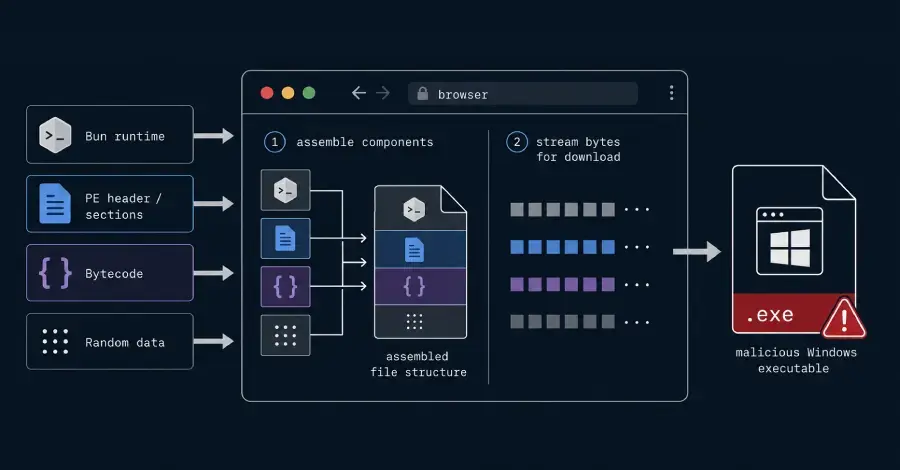
The delivery chain separates the final Windows file into components that are put together on the victim side.

The browser obtains a legitimate Bun runtime and combines it with attacker-controlled material delivered through the campaign infrastructure, so defenders may not see one finished malware file moving across the network.

The technique changes what defenders can observe without demonstrating a browser exploit.

Confiant did not identify a browser bug or report that Mark of the Web was removed.

Its analysis also did not establish whether the final download starts automatically or requires a user click.

Per-session file variation can still weaken hash-based detection because each generated file may differ.

Attribution Remains Unresolved

Confiant published three SHA-256 hashes and a malicious-domain list that The Hacker News counted at 96 domains, but did not name the actor behind the operation.

Bitdefender reported on a related TradingView malvertising cluster in September 2025; that earlier account did not mention Bun, so its description of payload capabilities cannot establish what the current files do.

Security teams therefore need to correlate ad referrals, cloaked landing pages, runtime retrieval, generated downloads and endpoint records.

The available research identifies the delivery chain but leaves the operator and confirmed post-download behaviour unresolved.

Share this article
inXf
Keep Reading

More Stories

Latest
Kepler Targets 2027 Production for HBM Replacement MemoryCloud & Data CentersOct 6, 2026Kepler Targets 2027 Production for HBM Replacement MemoryEE Times reports that Kepler Computing is preparing 3D ferroelectric memory for 2027 production, promising higher capacity and bandwidth per watt while limiting reliance on advanced-node lithography.Yokogawa Opens Singapore Hub For Industrial Cyber ResilienceCapital & PolicyOct 6, 2026Yokogawa Opens Singapore Hub For Industrial Cyber ResilienceYokogawa Engineering Asia has launched a Singapore center focused on OT cyber resilience, training, response planning and recovery coordination for Southeast Asia, Oceania and Taiwan.ClickFix Attack Uses Browser Cache To Hide Malware PayloadCybersecurityOct 6, 2026ClickFix Attack Uses Browser Cache To Hide Malware PayloadMicrosoft Threat Intelligence traced a ClickFix cache-smuggling method that preloads malware into browser caches, then uses file size checks and a pasted Run command to launch later credential-theft stages.VOA Tests Six-Month Startup Buildout Before Funding DecisionsFintech & Digital PaymentsOct 6, 2026VOA Tests Six-Month Startup Buildout Before Funding DecisionsTechCabal’s interview with VOA Venture Partners founder Victoria Olayide Adesanya describes a six-month build programme that lets the firm work inside African financial-infrastructure startups before deciding whether to invest.Bitcoin Holds $86,000 As Dollar Index Hits 18-Month HighCrypto/Web3Oct 6, 2026Bitcoin Holds $86,000 As Dollar Index Hits 18-Month HighCoinDesk reported that bitcoin stayed near $86,000 while the U.S. Dollar Index reached about 102.5, with U.S. rate expectations and European political risks strengthening the dollar backdrop.Google Freezes OSS Bug Bounty Reports After AI Submission FloodCybersecurityOct 6, 2026Google Freezes OSS Bug Bounty Reports After AI Submission FloodGoogle has stopped accepting new product vulnerability reports in its OSS VRP after invalid automated submissions swamped reviewers, while older reports and some Cloud VRP routes remain open.Fleuret AI Raises €4M For Continuous AI Pentesting PlatformCybersecurityOct 6, 2026Fleuret AI Raises €4M For Continuous AI Pentesting PlatformTech.eu reported that French startup Fleuret AI raised €4 million in pre-seed funding to develop an agentic-AI platform that turns penetration testing into a continuous security process.GFT Analysis Says AI Documentation Can Cut Maintenance Work 30%Fintech & Digital PaymentsOct 6, 2026GFT Analysis Says AI Documentation Can Cut Maintenance Work 30%A GFT Technologies analysis says AI-linked software documentation can cut maintenance effort and speed developer onboarding when knowledge assets stay synchronized with code changes.Schneider Electric Lines Up $22.6 Billion PTC DealAIOct 5, 2026Schneider Electric Lines Up $22.6 Billion PTC DealSchneider Electric plans to buy PTC in a cash transaction valuing the US engineering software provider’s equity at about $22.6 billion, adding product-lifecycle software to its industrial AI push.Aggarwal Pledges Ola Electric Stake To Fund ₹1,000 Cr Rights IssueCapital & PolicyOct 5, 2026Aggarwal Pledges Ola Electric Stake To Fund ₹1,000 Cr Rights IssueOla Electric founder Bhavish Aggarwal pledged 20 Cr shares to finance his participation in a rights issue that forms part of a larger ₹1,500 Cr fundraising plan.Natrona Schools AI Review Puts Student Privacy Ahead Of Classroom Tool UseAIOct 5, 2026Natrona Schools AI Review Puts Student Privacy Ahead Of Classroom Tool UseNatrona County trustees questioned whether teacher AI tools expose student data, even as existing district rules already ban unauthorized generative AI use by students.AMD Prices 256-Core EPYC 9996 At $14,904 For Server BuyersChips & SemiconductorsOct 5, 2026AMD Prices 256-Core EPYC 9996 At $14,904 For Server BuyersTechRadar reports that AMD’s 6th Gen EPYC 9006 “Venice” lineup includes a 256-core EPYC 9996 with 512 threads, 1GB of L3 cache, a 600W default power rating and a $14,904 list price for 1,000-unit orders.