Encord Tests Brain-Wave Data For Physical AI Training
Encord is testing brain-wave sensors with Zander Labs for robotics training data, TechCrunch reported, as physical AI developers look beyond video toward signals that capture intent, error and surprise.
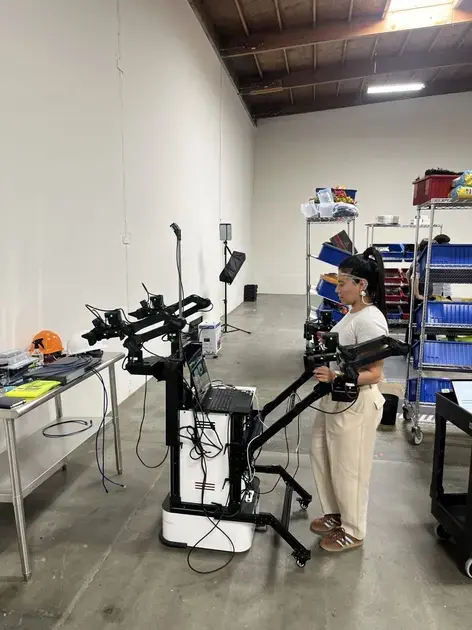
Robot training data is moving beyond camera footage into brain-wave signals, with Encord testing a Zander Labs headset at its San Leandro facility to determine whether human intent, error, and surprise can enhance physical AI models.
Brain-Wave Trial Tests A Robotics Data Gap
The work is still a trial rather than a production data product.
Encord’s plan is to build an initial brain-wave-tagged dataset, run it through customer robotics models and decide whether performance gains justify scaling the method.
Zander Labs developed the headset used in the trial.
The German neuroscience startup’s sensors are designed to infer mental states while a human trainer performs physical tasks, adding a signal that ordinary video does not capture.
Encord Builds Physical Datasets At San Leandro
Encord began as a company that assists machine-vision teams in annotating data and evaluating models.
Its robotics work now extends into producing training material because customers applying end-to-end learning to manipulation tasks require physical-world datasets that are not readily available online.
Vineeth Velmurugan, Encord’s head of robot learning, indicated that the needed dataset could be about five times the size of YouTube’s video corpus.
This scale explains why physical AI data collection is evolving into an operational business rather than remaining solely a research function.
San Leandro Facility Adds New Modalities
The San Leandro site combines egocentric video from workers wearing cameras, leader-follower robotic arms, and data gathered from several factories.
Stations were set up for trainers to create examples for pouring coffee, stacking poker chips, and handling objects used in household-task datasets.
One task involved plugging and unplugging ethernet cables from the back of a server, a job that data-center operators may want automated but still requires fine manipulation.
The limitation is physical: robotic pincers remain less dextrous than human fingers and do not match human arm movement.
Encord is also developing forearm sensors that detect electrical signals in muscles.
The goal is to reconstruct a fuller three-dimensional view of hand movement when camera footage misses parts of the hand.
Racks at the facility held flowers, books, plastic vegetables, kitty litter trays, scoops, and wiring bundles for household-task collection.
About a dozen pilots produce building blocks for neural networks, and several trainers previously worked at Scale, another AI data annotation company, before transitioning into robotics data work.
Dense Annotation Raises The Cost Of Physical AI
The company annotates physical datasets with descriptions such as a right hand tightening a bolt so language-model-based systems can interpret the action.
Velmurugan estimated that dense annotation can be worth 100 times as much as weaker egocentric data for specific tasks while costing 20 times more to produce.
Physical data must be staged, captured, labeled, and checked before it can train models for manipulation.
The commercial question for Encord is not whether more signals can be collected.
Customer robotics models still need to demonstrate that brain-wave tags, muscle sensors, and dense annotation improve task performance sufficiently to justify the costs of manufactured data.