SendTech Times
News
DEPLOYMENT WATCH:

Daifuku ties factory expansion and M&A to a bigger bet on semiconductor and logistics automation demand

Newsroom brief

Daifuku used a May 28, 2026 briefing in Tokyo to outline how heavier capital spending and selective acquisitions are meant to support its fiscal 2030 sales target of ¥1 trillion. The plan includes ¥1.6 trillion in investment across fiscal 2024-2027, added capacity in Shiga and Komaki, and the planned acquisition of Germany’s Eisenmann to strengthen its automotive business in Europe. The move matters beyond one company because it signals confidence that chip fabs, cleanroom production and large-scale intralogistics projects will keep demanding more complex material-handling systems and software.
Verified against source materialEdited by SendTech Times Chips & Compute DeskSource: Monoist
Daifuku ties factory expansion and M&A to a bigger bet on semiconductor and logistics automation demand
Image source: MONOist

What Happened

Daifuku on May 28, 2026, detailed growth investments tied to its long-term vision, “Driving Innovative Impact 2030,” under which it is targeting sales of ¥1 trillion by fiscal 2030.

The company said it will invest about ¥52 billion during 2026-2029 in areas including M&A and production capacity reinforcement to improve competitiveness.

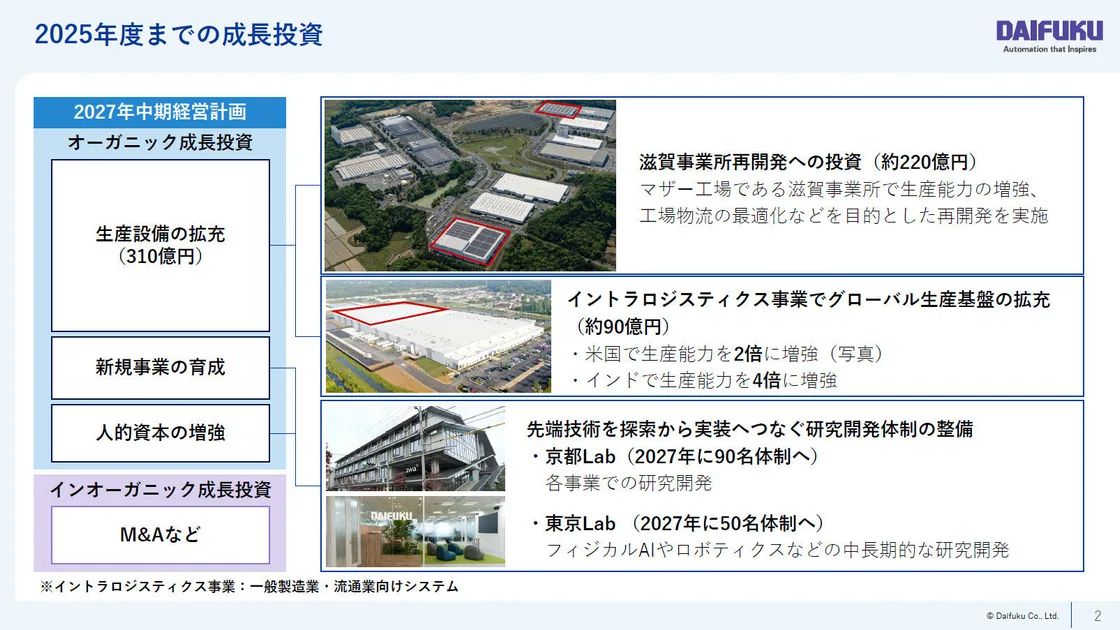
It also laid out a broader capital plan of ¥160 billion over fiscal 2024-2027: ¥80 billion already planned for regular equipment renewal and R&D over three years, plus an additional ¥80 billion strategic investment allocation.

The spending is intended for next-generation R&D and production equipment.

At its Shiga site in Hino, Shiga Prefecture, Daifuku has been redeveloping the mother factory since 2024 to raise production capacity and optimize factory logistics.

New buildings for general manufacturing and distribution systems began operating in July 2025, and a new building for semiconductor production-line systems began operating in April 2026.

Those projects involved about ¥22 billion.

Daifuku is now planning roughly ¥30 billion more for two additional Shiga buildings: one for intralogistics production capacity and warehouse use, and another warehouse building for the cleanroom and automotive businesses.

The Shiga site would then total 17 buildings.

The company is also investing about ¥10 billion to fully renovate an existing building at its Komaki site in Aichi Prefecture, which produces components including non-contact power supply devices, power panels and control panels for overhead hoist transport systems used in cleanrooms.

Construction and renovation are scheduled for completion during 2029-2030.

Daifuku said production space versus 2023 will expand to about 1.3 times in intralogistics and about 2 times in cleanroom operations.

Outside Japan, Daifuku said it is building a new factory in India to quadruple production capacity for its global intralogistics manufacturing base and renovating an existing US plant to double capacity.

In automotive, it announced in April 2026 that it would acquire Germany-based Eisenmann, which handles conveyor systems for auto production lines and industrial painting equipment.

The expected acquisition price is about ¥12 billion, with closing planned for July 2026.

The company said it will continue exploring M&A without setting constraints by industry or region.

R&D is also being expanded.

Daifuku set up Kyoto Lab in 2025 for advanced technologies needed by business divisions and established Tokyo Lab in 2026 to pursue mid- to long-term development in areas including physical AI and robotics.

By 2027, Kyoto Lab is planned to have 90 staff and Tokyo Lab 50.

Why It Matters

The immediate significance is that Daifuku is investing not only in floor space but in the ability to serve much larger and more software-intensive automation projects.

President Tomoaki Terai said projects that once involved 100 transport vehicles are now reaching 1,000 vehicles in a single large factory, and 10 connected factories could imply about 10,000 vehicles and total transport routes of 300 kilometers.

He also emphasized the importance of software reliability in running those systems.

That matters here because the company is positioning for demand where material handling is becoming a system-level bottleneck rather than a peripheral equipment purchase.

In semiconductor and cleanroom environments, delivery timing, uptime and integration quality could matter as much as hardware output.

If fab and advanced manufacturing investments stay elevated, suppliers able to scale both equipment production and control software may be better placed to win larger packages.

Global Context

This fits a wider industrial pattern in which automation suppliers are expanding near major manufacturing hubs and trying to deepen their role inside production workflows.

Broadly, semiconductor capacity build-outs, warehouse modernization and more automated automotive plants have increased demand for conveyors, hoist transport, controls and orchestration software.

Daifuku’s India and US capacity moves suggest a hedging strategy across regions, while the Eisenmann acquisition points to a push for stronger local relevance in Europe.

More generally, the competitive field is shifting from standalone machinery toward integrated platforms that combine equipment, power systems, controls, robotics and software.

The company’s use of the term physical AI in its Tokyo Lab plans suggests it sees future differentiation coming from smarter autonomous or semi-autonomous factory operations, though the commercial pace of that transition remains uncertain.

Industry Impact

For semiconductor and cleanroom customers, Daifuku’s expansion could improve supply assurance if demand remains strong, especially for overhead transport-related systems and adjacent controls.

For automotive manufacturers, the Eisenmann deal could broaden Daifuku’s process coverage in Europe beyond conveying into paint-related stages.

For rivals, the message is that scale, regional manufacturing footprint and software credibility are increasingly linked.

The announcement is also notable for showing that M&A is being treated as a capability tool, not only a market-share tool.

That could encourage further consolidation across specialist automation, controls and production-line engineering segments if customers continue favoring larger, end-to-end suppliers.

What To Watch Next

Key near-term markers are whether the Eisenmann acquisition closes in July 2026 as planned, whether the added Shiga and Komaki projects stay on schedule for 2029-2030 completion, and how quickly the labs scale to their planned 2027 headcounts.

Investors and customers will also likely watch whether cleanroom and intralogistics demand remains strong enough to justify the new capacity.

Another open question is how much of Daifuku’s future edge comes from software and AI-enabled control rather than purely from hardware output.

The article does not provide deployment-scale metrics beyond examples cited by management, nor does it disclose future revenue contribution by segment, so the commercial payoff from these investments will need to be tracked over time.
Share this article
inXf

Related articles

More
Oxmiq Raises $35 Million For GPU IP And AI Factory Design
Chips & Semiconductors

Oxmiq Raises $35 Million For GPU IP And AI Factory Design

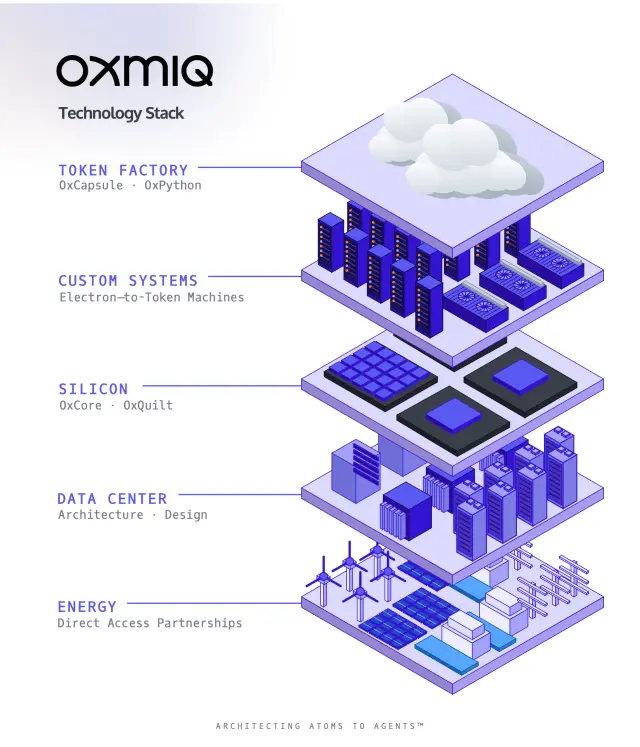
Oxmiq Labs raised $35 million in Series A funding, taking total funding to $60 million, as the startup expands from GPU IP toward data-centre-scale hardware, orchestration software and AI factory design, EE Times reported. Other large customers, production contracts and independent benchmarks remain outside the public record.

SK Hynix Plans Nasdaq ADR As AI Memory Demand Lifts Fundraising
Chips & Semiconductors

SK Hynix Plans Nasdaq ADR As AI Memory Demand Lifts Fundraising

SK Hynix plans a Nasdaq ADR listing that could raise 45.45 trillion won, giving global investors a new route into AI memory demand while capacity plans remain tied to Korea and Indiana.

China’s AI Boom Faces A Demand Test As Chip Bottlenecks Raise The Cost Of Growth
AI

China’s AI Boom Faces A Demand Test As Chip Bottlenecks Raise The Cost Of Growth

China’s AI investment exceeds one trillion yuan a year, but Nomura economist Lu Ting says chip constraints, capital-market gaps and city-level concentration limit its wider economic lift.

Taiwan Visit Highlights How AI Demand Is Pulling Chip Power, Capacity and Pricing Into One Orbit
Chips & Semiconductors

Taiwan Visit Highlights How AI Demand Is Pulling Chip Power, Capacity and Pricing Into One Orbit

Jensen Huang’s Taiwan visit was centered on partner meetings, a planned discussion with TSMC Chairman C.C. Wei, and Nvidia appearances tied to the Computex cycle. The episode points to a broader market phase in which AI chip demand is increasingly shaped by foundry access, packaging readiness, memory costs and ecosystem coordination. Investors, suppliers and device makers should watch whether Taiwan-related expansion signals translate into concrete capacity, site, and pricing outcomes.

Nvidia Japan AI Factory Plan Lists 140MW Capacity
Cloud & Data Centers

Nvidia Japan AI Factory Plan Lists 140MW Capacity

Tech Wire Asia reported that Nvidia’s Japan expansion includes a 140-megawatt AI factory using 13,750 Vera CPUs and 27,500 Rubin GPUs for the METI-backed FRONTia Project. The report did not name the site, capital cost, power supplier, construction timetable or first enterprise workloads.

Intel Commits 5 Billion Euros To Irish Fab 34 Expansion
Chips & Semiconductors

Intel Commits 5 Billion Euros To Irish Fab 34 Expansion

A 5 billion euro Leixlip investment puts Fab 34 back at the centre of Intel's European manufacturing plan for AI and high-performance computing processors. Most of the spending is due by the end of 2027, while a large external foundry customer for the Irish capacity remains unnamed, according to TNW.

AMD AI Forecast Tests Investor Trust In Helios Demand
Chips & Semiconductors

AMD AI Forecast Tests Investor Trust In Helios Demand

AMD told investors that data centre revenue should more than double in 2027 as Helios and MI450 deployments expand, but its shares fell after the results as AI demand concentration remained a concern.

Nexstrom Raises $12M To Push 2D Wafers Toward Chip Foundries
Chips & Semiconductors

Nexstrom Raises $12M To Push 2D Wafers Toward Chip Foundries

SiliconANGLE reported that Singapore startup Nexstrom raised $12 million to commercialize a 2D semiconductor wafer platform designed for 12-inch production and existing foundry workflows.

Keep Reading

More Stories

Latest
Ethereum Testnet Update Targets 200 Million-Gas BlocksCrypto/Web3Oct 6, 2026Ethereum Testnet Update Targets 200 Million-Gas BlocksEthereum developers released Prysm 7.2.1 so the Sepolia trial of Glamsterdam can test 200 million-gas blocks, more than three times the prior 60 million setting, before any main-network change.Kepler Targets 2027 Production for HBM Replacement MemoryCloud & Data CentersOct 6, 2026Kepler Targets 2027 Production for HBM Replacement MemoryEE Times reports that Kepler Computing is preparing 3D ferroelectric memory for 2027 production, promising higher capacity and bandwidth per watt while limiting reliance on advanced-node lithography.Yokogawa Opens Singapore Hub For Industrial Cyber ResilienceCapital & PolicyOct 6, 2026Yokogawa Opens Singapore Hub For Industrial Cyber ResilienceYokogawa Engineering Asia has launched a Singapore center focused on OT cyber resilience, training, response planning and recovery coordination for Southeast Asia, Oceania and Taiwan.ClickFix Attack Uses Browser Cache To Hide Malware PayloadCybersecurityOct 6, 2026ClickFix Attack Uses Browser Cache To Hide Malware PayloadMicrosoft Threat Intelligence traced a ClickFix cache-smuggling method that preloads malware into browser caches, then uses file size checks and a pasted Run command to launch later credential-theft stages.VOA Tests Six-Month Startup Buildout Before Funding DecisionsFintech & Digital PaymentsOct 6, 2026VOA Tests Six-Month Startup Buildout Before Funding DecisionsTechCabal’s interview with VOA Venture Partners founder Victoria Olayide Adesanya describes a six-month build programme that lets the firm work inside African financial-infrastructure startups before deciding whether to invest.Bitcoin Holds $86,000 As Dollar Index Hits 18-Month HighCrypto/Web3Oct 6, 2026Bitcoin Holds $86,000 As Dollar Index Hits 18-Month HighCoinDesk reported that bitcoin stayed near $86,000 while the U.S. Dollar Index reached about 102.5, with U.S. rate expectations and European political risks strengthening the dollar backdrop.Google Freezes OSS Bug Bounty Reports After AI Submission FloodCybersecurityOct 6, 2026Google Freezes OSS Bug Bounty Reports After AI Submission FloodGoogle has stopped accepting new product vulnerability reports in its OSS VRP after invalid automated submissions swamped reviewers, while older reports and some Cloud VRP routes remain open.Fleuret AI Raises €4M For Continuous AI Pentesting PlatformCybersecurityOct 6, 2026Fleuret AI Raises €4M For Continuous AI Pentesting PlatformTech.eu reported that French startup Fleuret AI raised €4 million in pre-seed funding to develop an agentic-AI platform that turns penetration testing into a continuous security process.GFT Analysis Says AI Documentation Can Cut Maintenance Work 30%Fintech & Digital PaymentsOct 6, 2026GFT Analysis Says AI Documentation Can Cut Maintenance Work 30%A GFT Technologies analysis says AI-linked software documentation can cut maintenance effort and speed developer onboarding when knowledge assets stay synchronized with code changes.Schneider Electric Lines Up $22.6 Billion PTC DealAIOct 5, 2026Schneider Electric Lines Up $22.6 Billion PTC DealSchneider Electric plans to buy PTC in a cash transaction valuing the US engineering software provider’s equity at about $22.6 billion, adding product-lifecycle software to its industrial AI push.Aggarwal Pledges Ola Electric Stake To Fund ₹1,000 Cr Rights IssueCapital & PolicyOct 5, 2026Aggarwal Pledges Ola Electric Stake To Fund ₹1,000 Cr Rights IssueOla Electric founder Bhavish Aggarwal pledged 20 Cr shares to finance his participation in a rights issue that forms part of a larger ₹1,500 Cr fundraising plan.Natrona Schools AI Review Puts Student Privacy Ahead Of Classroom Tool UseAIOct 5, 2026Natrona Schools AI Review Puts Student Privacy Ahead Of Classroom Tool UseNatrona County trustees questioned whether teacher AI tools expose student data, even as existing district rules already ban unauthorized generative AI use by students.