SendTech Times
News
SYSTEMS SHIFT:

AWS Lambda MicroVMs Add Stateful Sandboxes For AI-Generated Code

Newsroom brief

AWS has introduced Lambda MicroVMs for isolated, stateful execution environments, giving developers Firecracker-backed sandboxes for user- or AI-generated code with runtime, region and resource limits.

Verified against source materialEdited by SendTech Times Cloud & Infrastructure DeskSource: AWS News Blog
AWS Lambda MicroVMs Add Stateful Sandboxes For AI-Generated Code
Image source: Amazon Web Services

Lambda Gets A Stateful Sandbox Layer

The account comes from an official company announcement by AWS and does not include customer deployments, independent benchmark results or production incident data.

AWS has introduced Lambda MicroVMs, a new serverless compute primitive inside AWS Lambda for applications that need isolated execution environments for code generated by users or AI.

The service is aimed at a gap between virtual machines, containers and functions.

AWS says virtual machines provide strong isolation but can take minutes to start, while containers launch faster but share a kernel and require hardening when untrusted code is involved.

Functions are built for request-response workloads and are not designed for long-running interactive sessions that keep state across user interactions.

Lambda MicroVMs gives each end user or session its own isolated environment.

The environment can launch quickly, retain memory and disk state for the session, and pause at a lower idle cost when the user steps away.

The product is powered by Firecracker, the lightweight virtualization technology AWS says already supports more than 15 trillion monthly Lambda function invocations.

For developers building AI coding assistants, interactive code tools, data analytics platforms, vulnerability scanners or game servers with user scripts, the product reduces the need to operate custom virtualization infrastructure.

The service still leaves application teams responsible for packaging code, setting identity roles and deciding where untrusted code belongs in their workflow.

Firecracker Snapshots Replace Cold Starts

The operating model is image-then-launch.

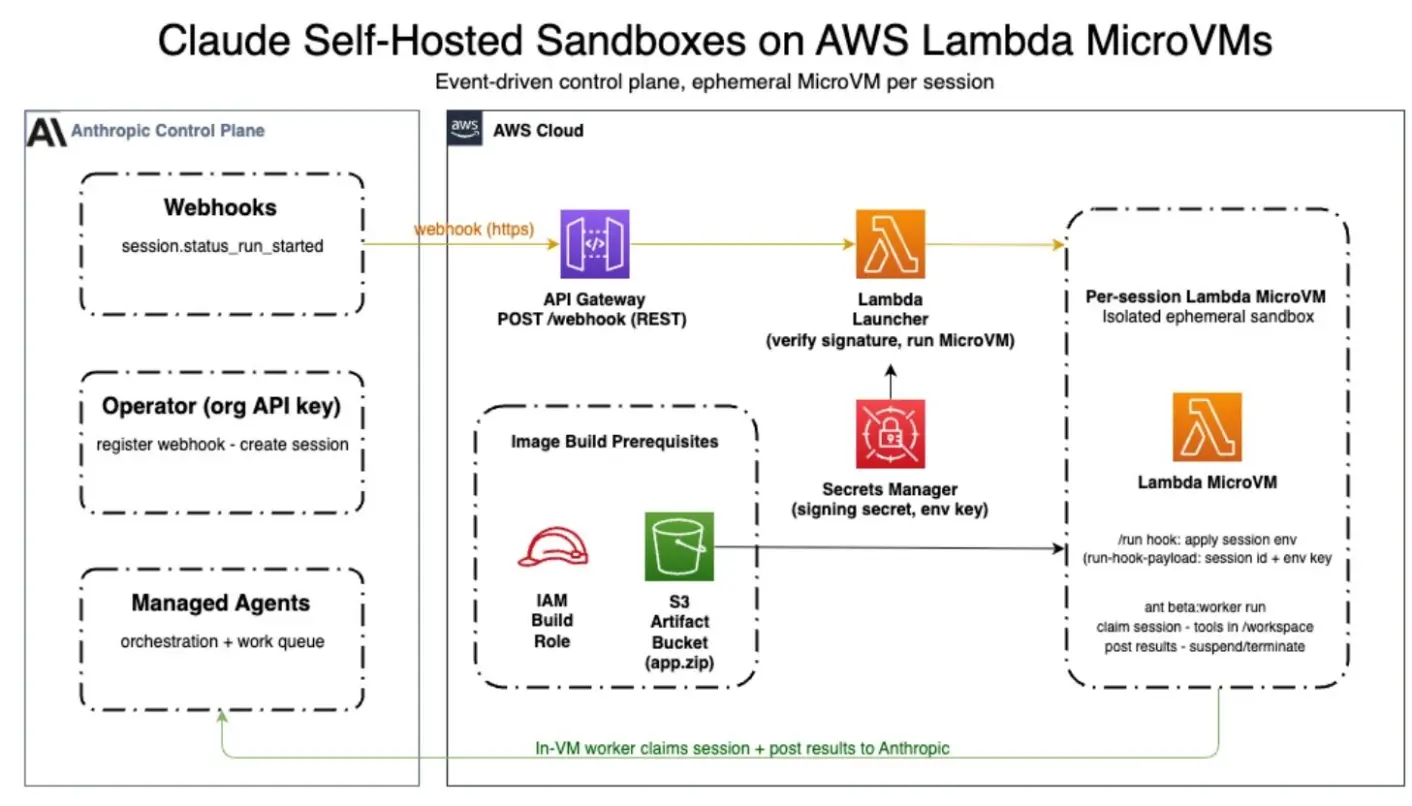
Developers create a MicroVM Image by providing a Dockerfile and code packaged as a zip artifact in Amazon S3.

Lambda runs the Dockerfile, initializes the application and takes a Firecracker snapshot of the running memory and disk state.

Later environments start from the prepared snapshot rather than a cold boot.

AWS says this is intended to provide near-instant launch and resume for interactive sessions, including sessions large enough to involve multi-gigabyte working environments.

The service also has a distinct API surface from Lambda Functions.

AWS says Lambda Functions remain the right fit for event-driven request-response workloads, while Lambda MicroVMs is for multi-tenant applications that need a dedicated environment for each user or session.

The product does not replace conventional functions.

A company could keep Lambda Functions as an event backbone and use Lambda MicroVMs only for steps that execute untrusted code in isolation.

Lifecycle Controls Define The Cost Boundary

AWS describes lifecycle control as one of the product's main differences.

A running MicroVM can retain memory, disk and active processes during a session.

During idle periods, it can be suspended with memory and disk state preserved, then resumed when traffic arrives.

In the example described by AWS, an idle policy auto-suspended the environment after 15 minutes of inactivity and auto-resumed it on the next incoming request.

AWS also gives each MicroVM a maximum total runtime of 8 hours, with automatic suspension available after a configurable idle window.

Those controls are important for applications where users step away but expect their environment to come back with packages, loaded models and working files still available.

The trade-off is that teams need to design around session length, idle policy, authentication and state recovery rather than treating serverless as only stateless execution.

Regions And Limits Set The Rollout Shape

Lambda MicroVMs is available today in US East in N. Virginia and Ohio, US West in Oregon, Europe in Ireland and Asia Pacific in Tokyo.

The service runs on ARM64 architecture.

AWS lists a ceiling of 16 vCPUs per MicroVM, with memory and disk each capped at 32 GB.

AWS says the service is available first in named regions on ARM64 architecture, while teams outside those regions still need to evaluate latency, data-location requirements and compatibility before moving untrusted-code workloads onto the new primitive.

The public record still lacks customer deployments, independent benchmark results, production incident data or adoption counts for Lambda MicroVMs; the announcement also leaves teams to compare the available regions, ARM64 requirement, 8-hour runtime ceiling and 32 GB memory and disk limits against their own AI coding, analytics or security workloads.

Share this article
inXf

Related articles

More
AWS Lambda MicroVMs Extend Serverless Jobs To Eight Hours
Cloud & Data Centers

AWS Lambda MicroVMs Extend Serverless Jobs To Eight Hours

AWS introduced Lambda MicroVMs, a Firecracker-based serverless option that can run isolated Linux containers for up to eight hours instead of the 15-minute Lambda function limit.

Railway Raises $100 Million As AI Coding Pushes Cloud Deployment Claims
Cloud & Data Centers

Railway Raises $100 Million As AI Coding Pushes Cloud Deployment Claims

Railway raised $100 million in a Series B round led by TQ Ventures, with the cloud startup citing more than 10 million deployments each month and two million developers, VentureBeat reported. Railway described sub-second deployment, customer cost-saving claims and its own data-centre buildout, but public detail did not include audited benchmarks, full enterprise contract values or customer-by-customer deployment scope.

AWS Adds Persistent Runtime Instances For Production AI Agents
Cloud & Data Centers

AWS Adds Persistent Runtime Instances For Production AI Agents

AWS announced runtime instances for Amazon Bedrock AgentCore Runtime, adding managed infrastructure for multi-agent workflows, shared sessions lasting up to 14 days and GPU-supported production agent deployments.

National Grid Backs Joulent With $1.75 Billion As AI Power Queues Stretch
Cloud & Data Centers

National Grid Backs Joulent With $1.75 Billion As AI Power Queues Stretch

National Grid Ventures plans a $1.75 billion minority investment in Joulent, a power developer built around dedicated generation for AI data centres. The deal supports Project Kilby in Texas, but delivery and interconnection risks remain outside the disclosed timetable.

Ofgem Grid Fee Would Make Data-Centre Developers Prove Demand
Cloud & Data Centers

Ofgem Grid Fee Would Make Data-Centre Developers Prove Demand

Data Center Knowledge covered Ofgem’s proposed refundable Data Centre Commitment Fee, which would attach delivery milestones and a per-megawatt security requirement to large British data-centre grid applications.

PJM Plan Makes AI Data Centres Bring Power Or Accept Curtailment
Cloud & Data Centers

PJM Plan Makes AI Data Centres Bring Power Or Accept Curtailment

Data Center Knowledge reported that PJM's proposed IRAS framework would separate grid connection from firm service for new AI-scale loads, pushing data centre developers to bring capacity, contract bilaterally or accept curtailment during shortages.

Grid Operators Seek Delay On FERC Data Centre Power Rules
Cloud & Data Centers

Grid Operators Seek Delay On FERC Data Centre Power Rules

Five of six U.S. grid operators asked FERC for more time on large-load interconnection rules, leaving data centre developers waiting for enforceable power-access tariffs.

Samsung Advances Floating AI Data Centre Units With Texas Developer
Cloud & Data Centers

Samsung Advances Floating AI Data Centre Units With Texas Developer

Data Center Knowledge reported that Samsung Heavy Industries signed an engineering agreement with Texas-based Mousterian Corporation for moored floating data centre units aimed at AI workloads. The plan centres on 50 MW units, initial Texas deployments and a reported commercialisation target in the second quarter of 2028, while customers, sites and firm orders remain undisclosed.

Keep Reading

More Stories

Latest
Ethereum Testnet Update Targets 200 Million-Gas BlocksCrypto/Web3Oct 6, 2026Ethereum Testnet Update Targets 200 Million-Gas BlocksEthereum developers released Prysm 7.2.1 so the Sepolia trial of Glamsterdam can test 200 million-gas blocks, more than three times the prior 60 million setting, before any main-network change.Kepler Targets 2027 Production for HBM Replacement MemoryCloud & Data CentersOct 6, 2026Kepler Targets 2027 Production for HBM Replacement MemoryEE Times reports that Kepler Computing is preparing 3D ferroelectric memory for 2027 production, promising higher capacity and bandwidth per watt while limiting reliance on advanced-node lithography.Yokogawa Opens Singapore Hub For Industrial Cyber ResilienceCapital & PolicyOct 6, 2026Yokogawa Opens Singapore Hub For Industrial Cyber ResilienceYokogawa Engineering Asia has launched a Singapore center focused on OT cyber resilience, training, response planning and recovery coordination for Southeast Asia, Oceania and Taiwan.ClickFix Attack Uses Browser Cache To Hide Malware PayloadCybersecurityOct 6, 2026ClickFix Attack Uses Browser Cache To Hide Malware PayloadMicrosoft Threat Intelligence traced a ClickFix cache-smuggling method that preloads malware into browser caches, then uses file size checks and a pasted Run command to launch later credential-theft stages.VOA Tests Six-Month Startup Buildout Before Funding DecisionsFintech & Digital PaymentsOct 6, 2026VOA Tests Six-Month Startup Buildout Before Funding DecisionsTechCabal’s interview with VOA Venture Partners founder Victoria Olayide Adesanya describes a six-month build programme that lets the firm work inside African financial-infrastructure startups before deciding whether to invest.Bitcoin Holds $86,000 As Dollar Index Hits 18-Month HighCrypto/Web3Oct 6, 2026Bitcoin Holds $86,000 As Dollar Index Hits 18-Month HighCoinDesk reported that bitcoin stayed near $86,000 while the U.S. Dollar Index reached about 102.5, with U.S. rate expectations and European political risks strengthening the dollar backdrop.Google Freezes OSS Bug Bounty Reports After AI Submission FloodCybersecurityOct 6, 2026Google Freezes OSS Bug Bounty Reports After AI Submission FloodGoogle has stopped accepting new product vulnerability reports in its OSS VRP after invalid automated submissions swamped reviewers, while older reports and some Cloud VRP routes remain open.Fleuret AI Raises €4M For Continuous AI Pentesting PlatformCybersecurityOct 6, 2026Fleuret AI Raises €4M For Continuous AI Pentesting PlatformTech.eu reported that French startup Fleuret AI raised €4 million in pre-seed funding to develop an agentic-AI platform that turns penetration testing into a continuous security process.GFT Analysis Says AI Documentation Can Cut Maintenance Work 30%Fintech & Digital PaymentsOct 6, 2026GFT Analysis Says AI Documentation Can Cut Maintenance Work 30%A GFT Technologies analysis says AI-linked software documentation can cut maintenance effort and speed developer onboarding when knowledge assets stay synchronized with code changes.Schneider Electric Lines Up $22.6 Billion PTC DealAIOct 5, 2026Schneider Electric Lines Up $22.6 Billion PTC DealSchneider Electric plans to buy PTC in a cash transaction valuing the US engineering software provider’s equity at about $22.6 billion, adding product-lifecycle software to its industrial AI push.Aggarwal Pledges Ola Electric Stake To Fund ₹1,000 Cr Rights IssueCapital & PolicyOct 5, 2026Aggarwal Pledges Ola Electric Stake To Fund ₹1,000 Cr Rights IssueOla Electric founder Bhavish Aggarwal pledged 20 Cr shares to finance his participation in a rights issue that forms part of a larger ₹1,500 Cr fundraising plan.Natrona Schools AI Review Puts Student Privacy Ahead Of Classroom Tool UseAIOct 5, 2026Natrona Schools AI Review Puts Student Privacy Ahead Of Classroom Tool UseNatrona County trustees questioned whether teacher AI tools expose student data, even as existing district rules already ban unauthorized generative AI use by students.