SendTech Times
News
DEPLOYMENT WATCH:

AFL’s AI Interconnect Thesis Moves Data Center Networks Into The Bottleneck

Newsroom brief

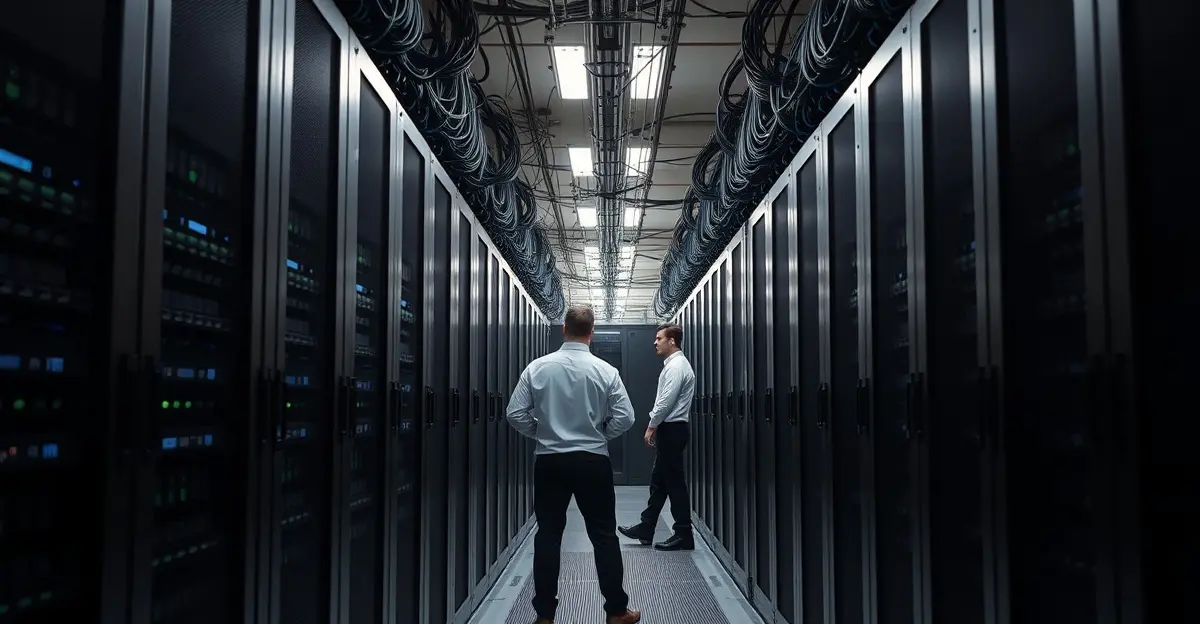
AFL’s Noah Taylor framed data center interconnect as a critical constraint for AI infrastructure, arguing that hyperscale networks now need denser fiber, faster deployment and tighter ecosystem integration as inference shifts more traffic upstream.
Verified against source materialEdited by SendTech Times Connectivity DeskSource: RCR Wireless News
AFL’s AI Interconnect Thesis Moves Data Center Networks Into The Bottleneck

AI Growth Pushes The Link Between Facilities Into View

AFL is treating data center interconnect as a central infrastructure constraint for AI, not as a secondary network layer behind new compute sites.

Noah Taylor, AFL’s head of market intelligence and growth strategy for broadband, said during an RCRTech webinar that AI demand is raising pressure on the links that connect data centers as hyperscalers expand deployments.

The claim is specific: Taylor said data center interconnect is scaling as much as, or more than, the data center market itself.

He tied that demand to hyperscale architectures that need mesh-style connections, multiple links between facilities and redundancy built into the network.

For AI infrastructure buyers, the issue is therefore not only whether a new facility has enough servers.

The surrounding optical, metro and access networks also have to move model traffic between sites without creating a new bottleneck.

Inference Changes The Traffic Shape

Taylor connected the interconnect problem to a shift in traffic direction.

AI inference is not only sending finished cloud content down to users.

More users and connected devices are uploading images, video and sensing data for processing, which increases upstream pressure on networks that were historically planned around heavier download flows.

He used two demand markers to explain the scale of the change.

ChatGPT reached 100 million users within 60 days of launch, and Taylor said AI agents can require “over 100 to 1,000 times” more compute than before.

Those figures do not by themselves prove how much capacity any one operator must build, but they explain why AFL is connecting AI adoption to bandwidth design, inter-facility routing and deployment speed rather than only to chip or server procurement.

Density, Speed And Ecosystem Fit Become One Package

Taylor described the interconnect technology stack through three requirements: density, speed of deployment and ecosystem integration.

Density means high-capacity fiber infrastructure that can support AI-scale links.

Speed matters because slow installation and splicing can leave compute assets idle after other parts of a project are ready.

Ecosystem integration means cables, closures, splicing systems and logistics have to work together instead of being handled as isolated procurement categories.

AFL used its own portfolio to illustrate that argument, including Spiderweb Ribbon fiber, high-density cable technologies and intelligent ribbon splicing systems for large deployments.

The commercial point is narrower than a general AI boom story.

Vendors that can shorten the time between network design and usable interconnect capacity may become more important as hyperscalers try to align facilities, fiber routes and operations schedules.

Taylor’s closing point also narrows the execution risk.

Adding more fiber is not enough if high-density networks, fast field work and compatible deployment tools are not planned together.

That makes DCI a coordination problem across materials, installation crews, splicing systems and logistics, not only a capacity problem measured by how many fiber routes are ordered.

Next Fiber Options Still Face Practical Hurdles

The webinar also pointed to hollow-core and multicore fiber as emerging options.

Hollow-core fiber sends light through an air core instead of solid glass, with potential latency and signal-loss advantages.

Multicore fiber could increase capacity by placing multiple cores inside one fiber.

Taylor also noted that these technologies are not ready to become default infrastructure without further work.

Standardization, interface compatibility, deployment practices and cost remain hurdles before broad adoption.

That limitation matters for AI infrastructure planning: the immediate buildout still depends on dense conventional fiber systems, rapid deployment practices and compatible toolchains, while newer fiber designs remain technologies to watch rather than guaranteed near-term replacements.

Share this article
inXf

Related articles

More
Ciena Says AI Data Centers Will Need More Than One Optical Network Design
Telco & Connectivity

Ciena Says AI Data Centers Will Need More Than One Optical Network Design

Ciena executive Helen Xenos says AI data center interconnect will mix coherent optics, photonic line systems, full-spectrum transponders, co-packaged optics and liquid cooling as scale-across deployments push capacity and reliability demands higher.

AI Inference Traffic Pushes Telecom Networks Toward a New Planning Problem
Telco & Connectivity

AI Inference Traffic Pushes Telecom Networks Toward a New Planning Problem

Light Reading says AI inference could create longer and more upstream-heavy telecom traffic than video-era networks were built to handle. Analysts cited in the report point to hyperscalers influence over optical transport, data-center interconnect and subsea capacity planning. Operators face a visibility gap because no comprehensive public study maps AI traffic patterns, even as the sector spends more than $600 billion in capex.

Ciena's $50 Billion AI Network Target Puts Optical Capacity on the Hyperscaler Clock
Telco & Connectivity

Ciena's $50 Billion AI Network Target Puts Optical Capacity on the Hyperscaler Clock

Ciena says AI demand could roughly double its addressable market to about $50 billion by 2029 as hyperscalers and service providers invest in optical networking. It cited RLS Hyper Rail, DCOM, coherent modules and 400G/800G pluggable optics as demand areas while planning $250 million to $275 million in capex this year. The practical question is whether AI compute buildouts convert into durable network orders.

Telecom Operators Test Whether AI Networks Can Move From Opex Cuts To Revenue
Telco & Connectivity

Telecom Operators Test Whether AI Networks Can Move From Opex Cuts To Revenue

Communications service providers are using generative and agentic AI to automate network operations, but the next test is whether distributed connectivity, edge sites and secure infrastructure can become paid AI services.

Amazon-Corning Fiber Deal Puts Optics Inside The AI Data Center Bottleneck
Cloud & Data Centers

Amazon-Corning Fiber Deal Puts Optics Inside The AI Data Center Bottleneck

Amazon has reached a multi-year optical fiber and networking agreement with Corning, adding North Carolina manufacturing jobs and highlighting fiber capacity as a practical constraint in AI data center expansion.

Lumilens Raises $700 Million as AI Data Centres Hit Network Limits
Cloud & Data Centers

Lumilens Raises $700 Million as AI Data Centres Hit Network Limits

Frontier Enterprise coverage shows Lumilens raising more than $700 million at a $5.51 billion valuation after its optical interconnect product moved into a hyperscaler’s production AI data centres.

India's 8.33 GW Data-Center Pipeline Tests AI Infrastructure Readiness
Cloud & Data Centers

India's 8.33 GW Data-Center Pipeline Tests AI Infrastructure Readiness

Knight Frank India says the country's data-center development pipeline has reached 8.33 GW, with Mumbai, Hyderabad and Chennai showing how AI demand is turning capacity, power, fibre and subsea links into strategic constraints.

Anterix And Lynk Test Satellite-To-Device Links For Utility Networks
Telco & Connectivity

Anterix And Lynk Test Satellite-To-Device Links For Utility Networks

Anterix and Lynk Global are testing whether 900 MHz private wireless spectrum can extend satellite-to-device connectivity into utilities and other critical infrastructure networks.

Keep Reading

More Stories

Latest
Kepler Targets 2027 Production for HBM Replacement MemoryCloud & Data CentersOct 6, 2026Kepler Targets 2027 Production for HBM Replacement MemoryEE Times reports that Kepler Computing is preparing 3D ferroelectric memory for 2027 production, promising higher capacity and bandwidth per watt while limiting reliance on advanced-node lithography.Yokogawa Opens Singapore Hub For Industrial Cyber ResilienceCapital & PolicyOct 6, 2026Yokogawa Opens Singapore Hub For Industrial Cyber ResilienceYokogawa Engineering Asia has launched a Singapore center focused on OT cyber resilience, training, response planning and recovery coordination for Southeast Asia, Oceania and Taiwan.ClickFix Attack Uses Browser Cache To Hide Malware PayloadCybersecurityOct 6, 2026ClickFix Attack Uses Browser Cache To Hide Malware PayloadMicrosoft Threat Intelligence traced a ClickFix cache-smuggling method that preloads malware into browser caches, then uses file size checks and a pasted Run command to launch later credential-theft stages.VOA Tests Six-Month Startup Buildout Before Funding DecisionsFintech & Digital PaymentsOct 6, 2026VOA Tests Six-Month Startup Buildout Before Funding DecisionsTechCabal’s interview with VOA Venture Partners founder Victoria Olayide Adesanya describes a six-month build programme that lets the firm work inside African financial-infrastructure startups before deciding whether to invest.Bitcoin Holds $86,000 As Dollar Index Hits 18-Month HighCrypto/Web3Oct 6, 2026Bitcoin Holds $86,000 As Dollar Index Hits 18-Month HighCoinDesk reported that bitcoin stayed near $86,000 while the U.S. Dollar Index reached about 102.5, with U.S. rate expectations and European political risks strengthening the dollar backdrop.Google Freezes OSS Bug Bounty Reports After AI Submission FloodCybersecurityOct 6, 2026Google Freezes OSS Bug Bounty Reports After AI Submission FloodGoogle has stopped accepting new product vulnerability reports in its OSS VRP after invalid automated submissions swamped reviewers, while older reports and some Cloud VRP routes remain open.Fleuret AI Raises €4M For Continuous AI Pentesting PlatformCybersecurityOct 6, 2026Fleuret AI Raises €4M For Continuous AI Pentesting PlatformTech.eu reported that French startup Fleuret AI raised €4 million in pre-seed funding to develop an agentic-AI platform that turns penetration testing into a continuous security process.GFT Analysis Says AI Documentation Can Cut Maintenance Work 30%Fintech & Digital PaymentsOct 6, 2026GFT Analysis Says AI Documentation Can Cut Maintenance Work 30%A GFT Technologies analysis says AI-linked software documentation can cut maintenance effort and speed developer onboarding when knowledge assets stay synchronized with code changes.Schneider Electric Lines Up $22.6 Billion PTC DealAIOct 5, 2026Schneider Electric Lines Up $22.6 Billion PTC DealSchneider Electric plans to buy PTC in a cash transaction valuing the US engineering software provider’s equity at about $22.6 billion, adding product-lifecycle software to its industrial AI push.Aggarwal Pledges Ola Electric Stake To Fund ₹1,000 Cr Rights IssueCapital & PolicyOct 5, 2026Aggarwal Pledges Ola Electric Stake To Fund ₹1,000 Cr Rights IssueOla Electric founder Bhavish Aggarwal pledged 20 Cr shares to finance his participation in a rights issue that forms part of a larger ₹1,500 Cr fundraising plan.Natrona Schools AI Review Puts Student Privacy Ahead Of Classroom Tool UseAIOct 5, 2026Natrona Schools AI Review Puts Student Privacy Ahead Of Classroom Tool UseNatrona County trustees questioned whether teacher AI tools expose student data, even as existing district rules already ban unauthorized generative AI use by students.AMD Prices 256-Core EPYC 9996 At $14,904 For Server BuyersChips & SemiconductorsOct 5, 2026AMD Prices 256-Core EPYC 9996 At $14,904 For Server BuyersTechRadar reports that AMD’s 6th Gen EPYC 9006 “Venice” lineup includes a 256-core EPYC 9996 with 512 threads, 1GB of L3 cache, a 600W default power rating and a $14,904 list price for 1,000-unit orders.