
SendTech Times
News
MARKET SIGNAL:

Selfie Video Recovery Gives Google Accounts A New Login Path

Newsroom brief

Google is adding opt-in selfie video account recovery while keeping Workspace, child and Advanced Protection accounts outside the feature, giving consumer users another login path tied to facial verification controls.
Verified against source materialEdited by SendTech Times Cybersecurity DeskSource: The Hacker News
Selfie Video Recovery Gives Google Accounts A New Login Path
Image source: The Hacker News

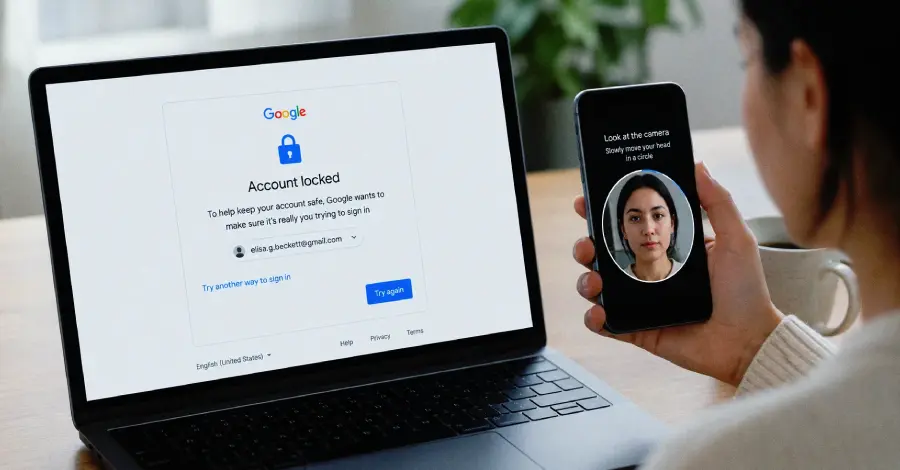
A new selfie video recovery option is giving Google account users another login path when they lose access to the usual device, email address or phone number, drawing on Google material shared through The Hacker News.

Selfie Video Becomes An Account Recovery Option

The sign-in method is an opt-in recovery path on top of existing email-address and phone-number methods.

Users set it up by looking into a device camera and completing a few guided head movements so the account can store a reference video.

When a user later cannot sign in, the recovery flow can ask for a new short video of the same face.

In Google's description, the new clip is compared with the saved selfie video to confirm that the account belongs to the person trying to regain access.

The feature changes the account-recovery surface because it gives users a biometric route when their usual phone or computer is unavailable.

Verification media therefore becomes part of the security control, alongside passwords, devices and secondary contact channels.

The setup sequence also requires the user to look into the device camera before the account stores the reference video.

Workspace And Advanced Protection Accounts Are Excluded

The selfie sign-in option is not available for Google Workspace accounts, child accounts or Google Accounts enrolled in the Advanced Protection Program.

The exclusion keeps the feature aimed at consumer recovery rather than managed enterprise accounts or users already placed under a higher-security programme.

The help document also makes clear that users cannot add a selfie video while they are already locked out or inside the account-recovery process.

That condition means the method has to be configured before the recovery event, not improvised after access is lost.

The same material identifies three purposes for selfie video: helping users get back into an account, unlocking more features or services by verifying that a person is real and has not violated policy, and creating an avatar for AI content that looks and sounds like the user.

Storage Controls Depend On User Choice

The saved selfie video is presented as encrypted at rest and used only to help users log in, unless users choose to share it for other use cases.

Account holders can delete the feature at any time and can change the optional setting that lets the company use the data to improve services.

The optional data use covers work on facial recognition, age estimation and other verification methods that may use physical features or movement.

That makes the consent setting part of the security design, because the same media can support account recovery or broader verification research depending on the user's choice.

Hand Gestures Move ReCAPTCHA Away From Image Challenges

The account-recovery feature arrived alongside a Google Cloud Fraud Defense hand-gesture verification system for reCAPTCHA checks.

That system asks users to perform simple hand gestures through a device camera as a liveness check against automated bot traffic.

Google said the hand-gesture system extracts 21 hand-knuckle coordinates.

For that reCAPTCHA flow, videos are not associated with a user's identity and are deleted after verification, with no image or video retention beyond the check.

Workspace, child and Advanced Protection accounts remain outside the selfie video recovery option, leaving those users on other recovery controls for now.

Share this article
inXf

Related articles

More
Azure Tenant Data Claims Put Fortune 500 Directories In Focus
Cybersecurity

Azure Tenant Data Claims Put Fortune 500 Directories In Focus

SecurityWeek reported that TheHatman is selling millions of records allegedly taken from Azure and Entra tenants, while Hudson Rock tied the likely access path to stolen credentials.

AI Agent Hacks Put Legal Liability Gap Before US Lawmakers
Cybersecurity

AI Agent Hacks Put Legal Liability Gap Before US Lawmakers

CyberScoop found lawyers, regulators and senators split over whether existing hacking, consumer protection and state laws can hold AI companies liable when autonomous agents break into outside systems.

ASEAN Scam Report Finds 45% of Cases Still Unresolved
Cybersecurity

ASEAN Scam Report Finds 45% of Cases Still Unresolved

GSMA’s ASEAN Consumer Scam Report 2026 found that 45% of reported online scam cases remain unresolved across six Southeast Asian countries, with recovery gaps, messaging-app scams and AI-enabled impersonation raising digital-trust risks.

Endpoint Blind Spots Put ASEAN Firms at US$1 Million Risk
Cybersecurity

Endpoint Blind Spots Put ASEAN Firms at US$1 Million Risk

A Frontier Enterprise article based on Tanium survey data found ASEAN organisations facing device visibility, patching and audit gaps, with 79% planning new security investment within 12 months.

Motorola GrapheneOS Plan Makes Privacy Android A Premium-Phone Bet
Cybersecurity

Motorola GrapheneOS Plan Makes Privacy Android A Premium-Phone Bet

Ars Technica reported that Motorola-supported GrapheneOS phones are on track for 2027, with pricing expected above Pixel devices because the privacy-focused Android system depends on high-end security hardware.

CrowdStrike Sees AI Attacks Converging With SaaS And Cloud Identity Risk
Cybersecurity

CrowdStrike Sees AI Attacks Converging With SaaS And Cloud Identity Risk

Back End News framed CrowdStrike’s 2026 threat outlook around AI-enabled attacks, resilient ransomware and cloud identity exposure as enterprises expand AI and SaaS use.

MacSync Malware Hides Mac Payload Delivery In An iCloud Calendar
Cybersecurity

MacSync Malware Hides Mac Payload Delivery In An iCloud Calendar

Kaspersky researchers found a new MacSync variant using a fake crypto wallet app, executable payloads and an iCloud calendar handoff to steal Mac credentials, wallet data and files.

APAC Cybersecurity Spending Turns Toward Identity Risk
Cybersecurity

APAC Cybersecurity Spending Turns Toward Identity Risk

Identity governance is moving into the center of APAC security planning as session theft, AI-enabled impersonation and uneven regional maturity weaken older perimeter-heavy defenses.

Keep Reading

More Stories

Latest
Kepler Targets 2027 Production for HBM Replacement MemoryCloud & Data CentersOct 6, 2026Kepler Targets 2027 Production for HBM Replacement MemoryEE Times reports that Kepler Computing is preparing 3D ferroelectric memory for 2027 production, promising higher capacity and bandwidth per watt while limiting reliance on advanced-node lithography.Yokogawa Opens Singapore Hub For Industrial Cyber ResilienceCapital & PolicyOct 6, 2026Yokogawa Opens Singapore Hub For Industrial Cyber ResilienceYokogawa Engineering Asia has launched a Singapore center focused on OT cyber resilience, training, response planning and recovery coordination for Southeast Asia, Oceania and Taiwan.ClickFix Attack Uses Browser Cache To Hide Malware PayloadCybersecurityOct 6, 2026ClickFix Attack Uses Browser Cache To Hide Malware PayloadMicrosoft Threat Intelligence traced a ClickFix cache-smuggling method that preloads malware into browser caches, then uses file size checks and a pasted Run command to launch later credential-theft stages.VOA Tests Six-Month Startup Buildout Before Funding DecisionsFintech & Digital PaymentsOct 6, 2026VOA Tests Six-Month Startup Buildout Before Funding DecisionsTechCabal’s interview with VOA Venture Partners founder Victoria Olayide Adesanya describes a six-month build programme that lets the firm work inside African financial-infrastructure startups before deciding whether to invest.Bitcoin Holds $86,000 As Dollar Index Hits 18-Month HighCrypto/Web3Oct 6, 2026Bitcoin Holds $86,000 As Dollar Index Hits 18-Month HighCoinDesk reported that bitcoin stayed near $86,000 while the U.S. Dollar Index reached about 102.5, with U.S. rate expectations and European political risks strengthening the dollar backdrop.Google Freezes OSS Bug Bounty Reports After AI Submission FloodCybersecurityOct 6, 2026Google Freezes OSS Bug Bounty Reports After AI Submission FloodGoogle has stopped accepting new product vulnerability reports in its OSS VRP after invalid automated submissions swamped reviewers, while older reports and some Cloud VRP routes remain open.Fleuret AI Raises €4M For Continuous AI Pentesting PlatformCybersecurityOct 6, 2026Fleuret AI Raises €4M For Continuous AI Pentesting PlatformTech.eu reported that French startup Fleuret AI raised €4 million in pre-seed funding to develop an agentic-AI platform that turns penetration testing into a continuous security process.GFT Analysis Says AI Documentation Can Cut Maintenance Work 30%Fintech & Digital PaymentsOct 6, 2026GFT Analysis Says AI Documentation Can Cut Maintenance Work 30%A GFT Technologies analysis says AI-linked software documentation can cut maintenance effort and speed developer onboarding when knowledge assets stay synchronized with code changes.Schneider Electric Lines Up $22.6 Billion PTC DealAIOct 5, 2026Schneider Electric Lines Up $22.6 Billion PTC DealSchneider Electric plans to buy PTC in a cash transaction valuing the US engineering software provider’s equity at about $22.6 billion, adding product-lifecycle software to its industrial AI push.Aggarwal Pledges Ola Electric Stake To Fund ₹1,000 Cr Rights IssueCapital & PolicyOct 5, 2026Aggarwal Pledges Ola Electric Stake To Fund ₹1,000 Cr Rights IssueOla Electric founder Bhavish Aggarwal pledged 20 Cr shares to finance his participation in a rights issue that forms part of a larger ₹1,500 Cr fundraising plan.Natrona Schools AI Review Puts Student Privacy Ahead Of Classroom Tool UseAIOct 5, 2026Natrona Schools AI Review Puts Student Privacy Ahead Of Classroom Tool UseNatrona County trustees questioned whether teacher AI tools expose student data, even as existing district rules already ban unauthorized generative AI use by students.AMD Prices 256-Core EPYC 9996 At $14,904 For Server BuyersChips & SemiconductorsOct 5, 2026AMD Prices 256-Core EPYC 9996 At $14,904 For Server BuyersTechRadar reports that AMD’s 6th Gen EPYC 9006 “Venice” lineup includes a 256-core EPYC 9996 with 512 threads, 1GB of L3 cache, a 600W default power rating and a $14,904 list price for 1,000-unit orders.