SendTech Times
Guide
SYSTEMS SHIFT:

Japan’s AI Suitcase Turns Assistive Mobility Into a Robotics Test Case

Newsroom brief

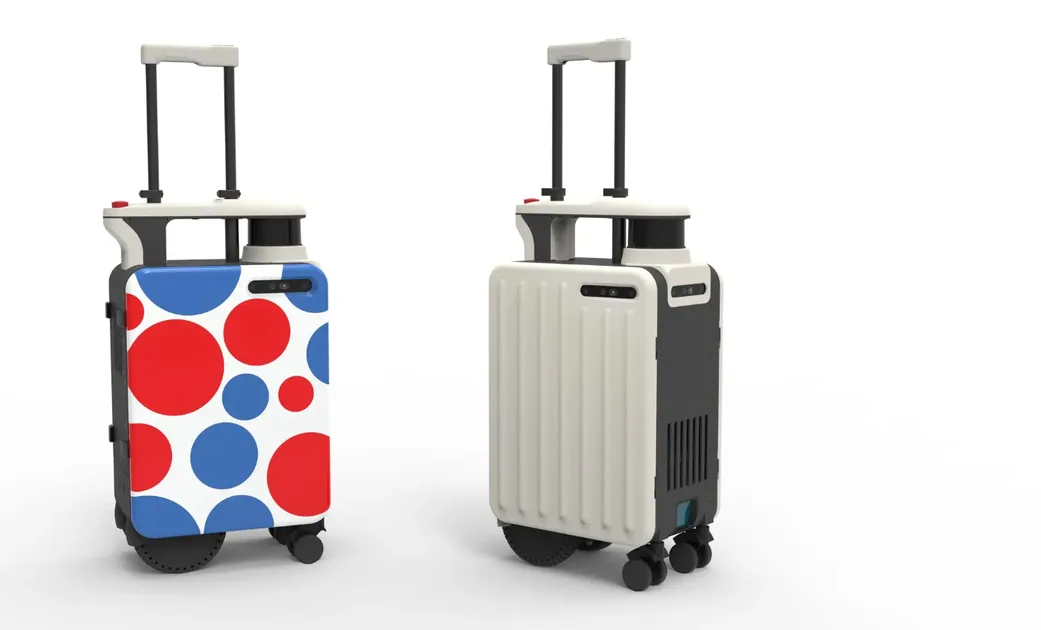
CAAMP, a consortium that includes university research institutes and IBM Japan, has developed the AI Suitcase to guide visually impaired users with sensors, cameras, motors and AI. The suitcase is being tested at locations including Miraikan, New Chitose Airport and Tokyo’s Nihonbashi district, where 39 visually impaired participants completed a monthlong indoor trial without collisions. An updated indoor-and-outdoor model is planned for Expo 2025 in Osaka, with CAAMP aiming to collect feedback from 2,000 to 3,000 people without visual disabilities.
Verified against source materialEdited by SendTech Times AI & Enterprise DeskSource: Jstories
Japan’s AI Suitcase Turns Assistive Mobility Into a Robotics Test Case
Image source: JStories / Consortium for Advanced Assistive Mobility Platform (CAAMP)

What happened

A Japanese assistive-technology consortium has pushed the AI Suitcase from research concept toward public demonstration, positioning a suitcase-shaped robot as a potential mobility aid for people with visual disabilities.

The Consortium for Advanced Assistive Mobility Platform, or CAAMP, includes university research institutes and major companies such as IBM Japan.

The device combines a computer, image-recognition sensors, cameras and motors to guide a user toward a selected destination.

Users choose where they want to go through a smartphone app, grip the handle and receive directional cues through handle vibration.

Releasing the handle stops the suitcase.

The system also uses LiDAR to judge distance from obstacles and real-time kinematics technology based on satellite signals and ground-station data.

The onboard computer processes that information so the robot can estimate its location in more complex outdoor settings.

CAAMP is also exploring functions that use cloud data and image recognition to describe nearby shops, people and products.

Why it matters

The project is a market signal for robotics beyond factory automation.

Japan is testing whether AI navigation, sensor fusion and human-machine interaction can become practical infrastructure for accessibility in public spaces.

If the system proves reliable, it could affect airports, museums, shopping centers and transport hubs that need safer ways to support independent mobility.

The work also shows how assistive robotics may depend less on a single breakthrough than on the integration of several mature technologies: smartphone interfaces, computer vision, LiDAR, localization and edge computing.

The commercial question is whether those parts can operate smoothly in crowded indoor and outdoor environments.

Who is affected

The primary users are people with visual disabilities who may need navigation support in places where guide dogs are restricted or where route guidance requires more precise destination control.

Public-venue operators could also be affected if assistive robots become part of accessibility planning.

The project was initiated by Chieko Asakawa, chief executive director of the National Museum of Emerging Science and Innovation, known as Miraikan, and a fellow at the University of Tokyo’s Research Center for Advanced Science and Technology.

Demonstration testing has taken place at large shopping malls, New Chitose Airport in Hokkaido, Miraikan in Tokyo and the outdoor route between Miraikan and the nearest train station.

In a monthlong Nihonbashi district test in September 2022, 39 visually impaired participants used the AI Suitcase to reach multiple destinations on the same floor of a building.

The test ended with all users arriving safely and without collisions or other reported problems.

What to watch next

The next proving ground is Expo 2025 in Osaka, where the AI Suitcase has been selected for a Robot Experience exhibit.

A special model designed for both indoor and outdoor use is planned, with improvements including wheels intended to handle steps more easily and a sensor designed to detect low obstacles.

Masashi Oikawa of CAAMP said the group wants to improve technical performance for indoor and outdoor use and check non-functional requirements such as social acceptability and legal compliance.

CAAMP hopes 2,000 to 3,000 people without visual disabilities will test or experience the suitcase during the expo.

Readers should watch whether the expo tests show that the system can handle crowds, uneven surfaces and public-space rules.

Those results may determine whether AI mobility assistance remains a demonstration project or moves closer to real deployment.


Share this article
inXf

Related articles

More
liko.ai Funding Turns Edge AI Into a Smart-Home Hardware Test
AI

liko.ai Funding Turns Edge AI Into a Smart-Home Hardware Test

liko.ai completed its first-round financing to fund edge-side vision-language models, AI-native hardware and multi-modal home terminals. The investor group includes Shangtang Guoxiang Capital, Orient Fortune Capital, iFlytek Venture Capital, Hongtai Fund, Zhengxuan Investment and Mianbi Intelligence. The practical question is whether the startup can turn camera-based edge AI into a consumer smart-home hub without relying on cloud processing.

Fujitsu pairs OpenAI and Anthropic deals for enterprise AI push
AI

Fujitsu pairs OpenAI and Anthropic deals for enterprise AI push

Fujitsu announced cooperation with OpenAI and a strategic partnership with Anthropic on the same day. The company plans to use ChatGPT Enterprise, Codex and Claude internally and in customer-facing enterprise AI services. Fujitsu says it will combine external models with Fujitsu Kozuchi, Takane, cybersecurity work and a Forward Deployed Engineer model.

Hitachi Tests Claude for Critical Infrastructure AI
AI

Hitachi Tests Claude for Critical Infrastructure AI

Hitachi partnered with Anthropic to strengthen Lumada 3.0 and bring Claude into mission-critical infrastructure settings. The plan covers HMAX solutions, cybersecurity work, internal deployment to about 290,000 employees and training for around 100,000 AI professionals. The main test is whether safety-focused generative AI can become reliable enough for regulated operational workflows.

MiniMax M3 turns long-context AI into an agent platform test
AI

MiniMax M3 turns long-context AI into an agent platform test

MiniMax launched M3 on June 1, 2026, combining long-context, agentic, coding and native multimodal capabilities in one model line. The API supports up to 1 million tokens of context, with a guaranteed minimum of 512K tokens, and includes M3 and M3-highspeed versions. MiniMax plans to open-source M3 on HuggingFace and GitHub, while early pricing offers a 50% discount for the first seven days.

RideFlux Turns Korea’s Driverless Permits Into A Physical-AI Test
AI

RideFlux Turns Korea’s Driverless Permits Into A Physical-AI Test

RideFlux is pushing Level 4 autonomous-driving software from Korea’s driverless passenger permits into paid freight operations, using urban edge-case data, faster inference and licensing partnerships as its commercialization proof points.

Anthropic’s Fable 5 Suspension Turns Sovereign AI Into A Live Dependency Test
AI

Anthropic’s Fable 5 Suspension Turns Sovereign AI Into A Live Dependency Test

Anthropic’s forced block on Claude Fable 5 and Claude Mythos 5 puts India’s sovereign AI debate on firmer ground, linking model access, export controls and startup architecture choices.

Claude Fable 5 Turns AI Safety Controls Into A China Model-Access Test
AI

Claude Fable 5 Turns AI Safety Controls Into A China Model-Access Test

Anthropic’s Claude Fable 5 restrictions show how frontier AI providers can move safety and anti-distillation controls into the model layer, creating new friction for Chinese developers.

Fujitsu-Led Frontria Pushes Japan Into Global AI Disinformation Fight
AI

Fujitsu-Led Frontria Pushes Japan Into Global AI Disinformation Fight

Fujitsu is coordinating Frontria, an international consortium focused on AI disinformation, trustworthiness, security, and regulatory frameworks. The group began with more than 50 organizations and has grown to about 70, with a target of more than 100 participants by fiscal 2026. The initiative highlights Japan’s effort to connect regional AI governance priorities as synthetic media and misinformation become infrastructure-level risks.

Keep Reading

More Stories

Latest
CDC Funding Plan Revives Fight Over Guinea-Bissau Vaccine TrialLifestyleOct 12, 2026CDC Funding Plan Revives Fight Over Guinea-Bissau Vaccine TrialCDC staff were told to reserve $1.6 million for a suspended hepatitis B vaccine trial in Guinea-Bissau, renewing objections over a study design that would leave some newborns unvaccinated.Buntar Aerospace Raises $16 Million To Expand Combat Drone AutonomyPoliticsOct 11, 2026Buntar Aerospace Raises $16 Million To Expand Combat Drone AutonomyUkrainian defense-tech company Buntar Aerospace raised $16 million to expand manufacturing, engineering hiring and autonomous drone systems beyond its reconnaissance hardware and combat software base.Vijil DART Tests Enterprise AI Agents With Adaptive Red TeamingCybersecurityOct 11, 2026Vijil DART Tests Enterprise AI Agents With Adaptive Red TeamingHelp Net Security reported that Vijil released DART, an adaptive red-teaming system that uses adversarial agents to test enterprise AI agents across tools, memory and multi-turn behavior.UK Fibre Deals Face Split Tests As Nexfibre And BT Reviews DivergePoliticsOct 11, 2026UK Fibre Deals Face Split Tests As Nexfibre And BT Reviews DivergeCapacity Media reported that UK regulators are applying competition and public-interest tests to separate broadband consolidation deals involving nexfibre, Netomnia, BT and TalkTalk.Enveda Raises $311M To Push AI-Discovered Medicines Deeper Into TrialsAIOct 11, 2026Enveda Raises $311M To Push AI-Discovered Medicines Deeper Into TrialsFrontier Enterprise reported that Enveda closed a $311 million round led by Catalio Capital Management after two early clinical readouts for PRISM-discovered medicines.Indian Startup Funding Falls To $122.9 Million Despite More DealsFintech & Digital PaymentsOct 11, 2026Indian Startup Funding Falls To $122.9 Million Despite More DealsIndian startups raised $122.9 million across 25 deals in the first week of October, led by DailyObjects, Lumio, Beyond Appliances and StockGro, while IPO and acquisition moves kept the pipeline active.Oxide Raises $445M to Scale Rack-Level Cloud HardwareChips & SemiconductorsOct 11, 2026Oxide Raises $445M to Scale Rack-Level Cloud HardwareOxide Computer raised $445 million in Series D funding led by Eclipse Capital as demand for its pre-integrated data centre racks exceeds supply and the company prepares GPU-capable hardware upgrades.IBM and Red Hat Backport Fixes for 400-Plus Open Source BugsCybersecurityOct 11, 2026IBM and Red Hat Backport Fixes for 400-Plus Open Source BugsIBM and Red Hat say Lightwell has remediated more than 400 previously unknown vulnerabilities in Java libraries, while the new Clearinghouse gives customers a way to submit dependencies for priority review and fixes.Upscale AI Pairs Nvidia Spectrum-X With Its Own SkyHammer FabricChips & SemiconductorsOct 11, 2026Upscale AI Pairs Nvidia Spectrum-X With Its Own SkyHammer FabricUpscale AI is building SkyHammer as a scale-up fabric for AI clusters while using Nvidia Spectrum-X for scale-out switches, a strategy that tests whether Ethernet-based designs can challenge proprietary accelerator domains.Anthropic Opens Free AI Vulnerability Scanner For Open SourceCybersecurityOct 11, 2026Anthropic Opens Free AI Vulnerability Scanner For Open SourceAnthropic is offering open-source projects free AI security scans, with model-generated reports that may speed vulnerability checks but arrive without human triage.Vatar Raises $500,000 After Lagos Life Browser Game Surges to 4.3 Million UsersAIOct 11, 2026Vatar Raises $500,000 After Lagos Life Browser Game Surges to 4.3 Million UsersVatar Inc. has raised a $500,000 angel round at a $10 million valuation after Lagos Life reached 4.3 million registered users, giving the young Nigerian browser-game company capital for product, marketing and hiring.Anthropic Program Pairs Claude With Infrastructure Security TeamsAIOct 10, 2026Anthropic Program Pairs Claude With Infrastructure Security TeamsAnthropic is pairing Claude models, its engineers and outside cybersecurity firms to scan critical infrastructure and open-source software for vulnerabilities, with an opt-in service for maintainers.