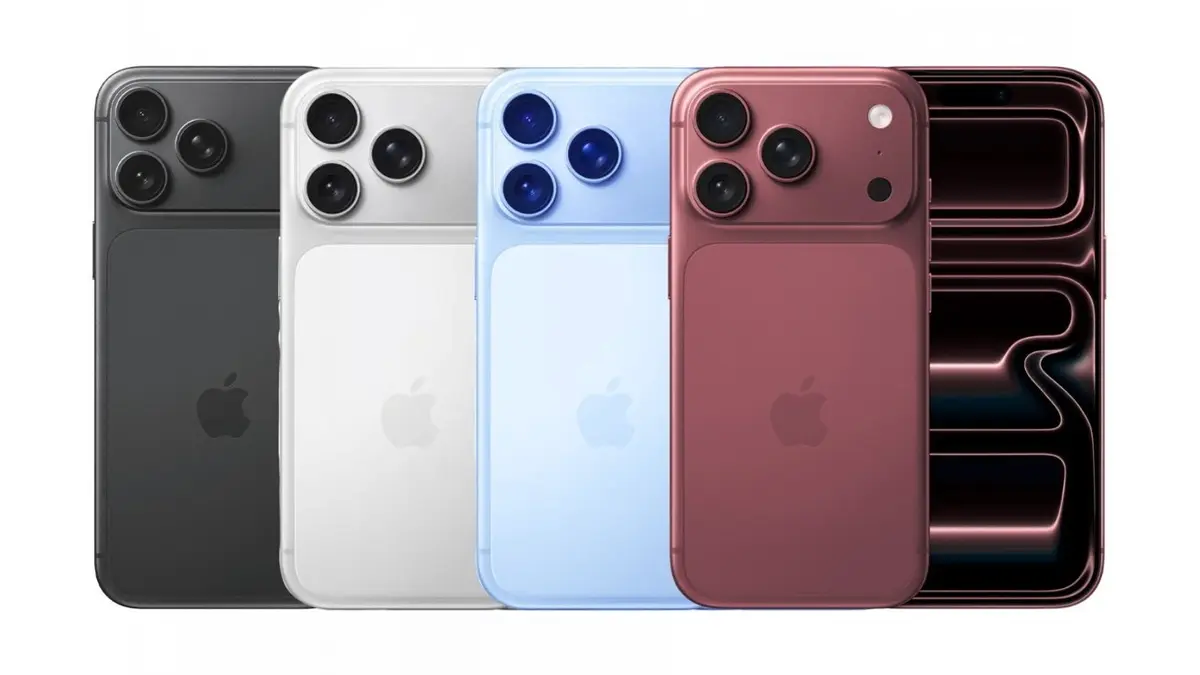
Apple Prices Foldable iPhone Duo From $1,999 After Hardware Launch
Apple introduced the iPhone Duo with a 7.6-inch inner display, A20 Pro chip and $1,999 starting price, while refreshing iPhone Pro, Watch and AirPods lines.

According to Engadget, Apple introduced the iPhone Duo alongside the iPhone 18 Pro family, new Watch models and updated AirPods at its latest event.
The launch changes the hardware question for customers from whether the company will enter foldables to what tradeoffs it chose for a first generation device.
The Duo uses a book-style format with a 7.6-inch Super Retina main display inside and a 5.4-inch exterior screen, putting a tablet-like workspace into a device that still folds into a pocketable shape.
The company kept the Duo closer to its premium iPhone architecture than to a separate tablet line.
The device runs on the A20 Pro chip also used in the iPhone 18 Pro models, includes support for Apple Pencil on both displays, and is built around software changes that let users run two apps or two instances of the same app on the main screen.
The design comes with clear physical decisions.
Open, the Duo is 0.21 inches, or 5.2 mm, thick; folded, it measures 0.44 inches, or 11.3 mm.
It weighs 8.96 ounces, or 254 grams.
The Duo is also eSIM-only, a move the company linked to freeing more internal space for battery capacity.
Battery life is one of the first proof points presented for the foldable design.
The company claims up to 44 hours of video playback on the external display, about 24 hours of use when both screens are used equally, and five hours of external-screen video after five minutes of wired charging.
The disclosed battery figures provide the first comparison point for daily use across the two displays.
The durability specifications cover the enclosure and display.
The Duo carries an IP68 rating for water and dust protection, while the hinge uses carbon fiber support plates with a titanium frame and hinge cover.
The company also added a nano texture on the display with a scratch-resistant coating.
The disclosed protection stack combines the hinge, frame and display coating in the first-generation device.
The camera system combines two rear lenses with the folding form factor.
The Duo has a 48MP main camera and a 48MP ultrawide camera, but no dedicated telephoto camera.
Its folding body can act as a stand for photos or video, and the outer display can help subjects see framing while a shot is being lined up.
Face ID is also absent; Apple put Touch ID in the side button, with a paired Watch available for unlocking as another route.
Software is where the foldable design has to earn its difference.
The software shifts controls such as the Home Screen dock and music playback buttons to the side of the external screen to preserve vertical space.
Its own apps have been optimized for the dual-display layout, and third-party examples include Netflix letting users browse clips on the smaller display before moving to the main screen.
Pricing places the Duo above the standard iPhone.
It starts at $1,999 with 256GB of storage and rises through 512GB, 1TB and 2TB versions, with the 2TB model priced at $3,199.
Pre-orders open October 16, and the first customer deliveries are scheduled for October 23.
The conventional phone lineup received its own hardware update.
The iPhone 18 Pro and 18 Pro Max use the A20 Pro, a 2nm chip with a six-core CPU, seven-core GPU and 32-core neural engine.
The company claims the CPU’s two desktop-class super cores are 20 percent faster than the previous generation, while graphics performance rises by up to 40 percent and memory bandwidth is 50 percent higher than on the A19 Pro.
Connectivity and thermal changes were part of that Pro pitch.
The phones include the N1 chip for Wi-Fi 7, Bluetooth 6 and Thread, plus a C2 modem that Apple says improves uploads compared with C1X while using 15 percent less energy.
A new vapor chamber has three times the surface area of the iPhone 17 Pro system and is described as delivering a 40 percent cooling-performance improvement.
The Pro models also reflect the company’s higher price baseline.
The iPhone 18 Pro starts at $1,199 and the Pro Max at $1,299, each $100 above the prior generation.
Pre-orders open September 12, with availability on September 18.
The company also said eSIM-only versions will be sold not just in the US but in markets including Bahrain, Kuwait, Oman, Qatar, Saudi Arabia and the UAE.
Siri AI sits across the new devices rather than being limited to one phone.
The revamped, Gemini-powered assistant is part of iOS 27 and related operating systems, with the public iOS 27 release scheduled for September 14.
It will be English-only at first, with French, Japanese, Korean, Portuguese and Spanish support due in October, while availability is delayed indefinitely in the EU and unavailable in China.
The watch and audio updates filled out the ecosystem side of the event.
Watch Series 12 starts at $399, adds upgraded internals, faster charging and an optional Audio Intelligence feature that can alert users to environmental sounds, transcribe the last 15 seconds of a conversation and summarize chats through Siri.
Watch Ultra 4 starts at $799 and is rated for up to 50 hours of everyday use or 84 hours in low power mode.
AirPods 5 arrived in two versions: a $129 entry model with open-ear active noise cancellation and a $149 model that adds wireless charging and on-stem volume control.
The company says the entry model removes up to 50 percent more external noise than AirPods 4 and offers up to four hours of listening with noise cancellation enabled, while the higher model runs up to five hours with ANC on.
The product spread leaves Apple with several staged tests rather than one simple refresh.
The Duo has to prove that the company’s hinge, battery, app layout and price choices can make a foldable feel like a premium iPhone instead of a niche experiment.
The Pro phones have to justify their higher prices through the A20 Pro, camera and cooling changes.
The watches, AirPods and Siri AI rollout then determine whether the surrounding ecosystem can make the new hardware feel coordinated after launch dates begin on September 18 and continue into October.