Anthropic Adds Nvidia BioNeMo Toolkit To Claude Science Beta
Anthropic has launched a Claude Science public beta that integrates Nvidia BioNeMo Agent Toolkit. AI News cited 18 of the top 20 drugmakers using BioNeMo, while the public record still lacks beta-user counts, named Claude Science customers or independent benchmark methodology.

Anthropic has opened a public beta of Claude Science, a research workbench that lets scientists use natural-language requests to run computational life-sciences workflows through Nvidia’s BioNeMo Agent Toolkit.
The integration makes Nvidia-accelerated models, libraries and NIM microservices callable inside Claude, giving researchers a way to invoke specialised computing tools without manually configuring predictive models, network endpoints or complex software environments.
Natural-language research workflows
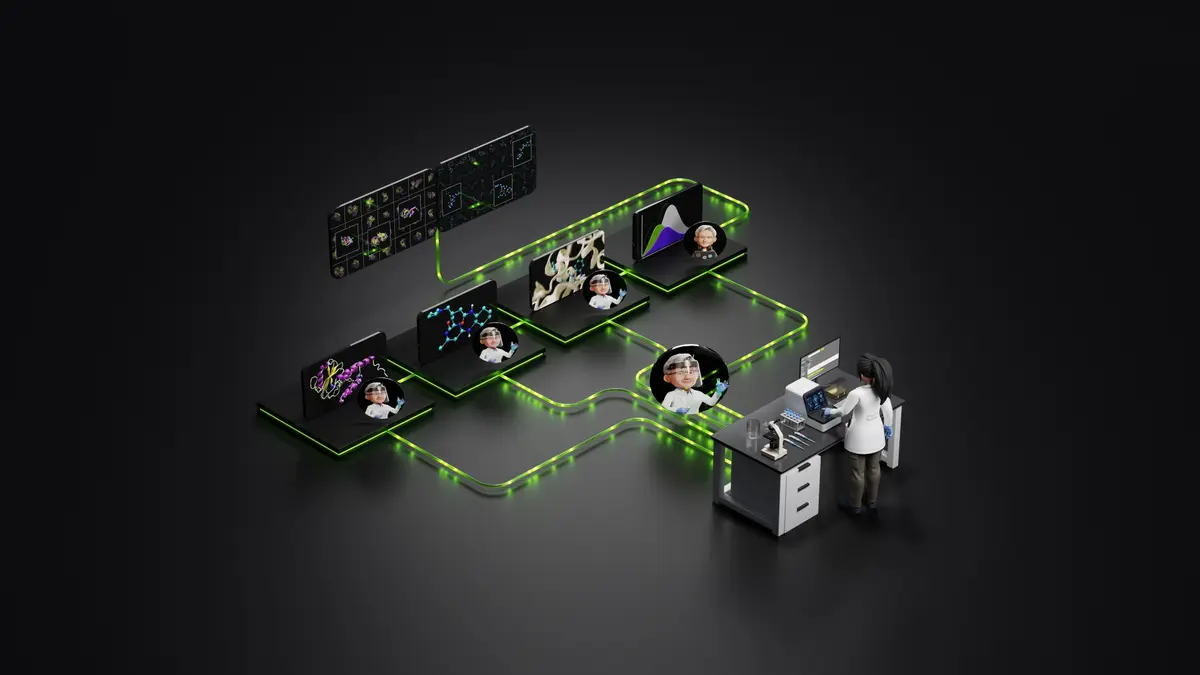
Claude Science is designed to translate a scientist’s request into a sequence of operational steps.
A researcher might ask it to analyse a genomic sequence, predict a protein structure or design a potential molecular binder.
The system interprets the request, selects domain-specific agents and maps each step to the relevant BioNeMo capability before returning the output for human review.
The BioNeMo Agent Toolkit packages accelerated functions as callable programmatic skills.
Each skill includes information about its purpose and required data inputs, allowing Claude Science to format valid requests, execute the work on deployed Nvidia computing resources and return the result.
The workflow covers genomics, proteomics, single-cell analysis, cheminformatics and clinical research.
A molecular-design workflow could begin with a known cancer-causing antigen mutation.
Claude Science can then be asked to generate possible inhibitors, while BioNeMo and Nvidia NIM microservices coordinate high-throughput prediction, optimisation and later validation.
The scientist reviews the outputs, refines the request and determines the next step.
Faster genomic and molecular analysis
The toolkit provides access to open models including Evo 2, Boltz-2 and OpenFold3, alongside Nvidia software libraries and specialised computational tools.
Those tools are important because an agent’s workflow can involve fingerprinting a large compound library, clustering molecular hits, generating conformers, analysing genomic context and comparing perturbation responses before recommending a laboratory experiment.
The source cited several tool-level performance figures.
Genomic analysis through Nvidia Parabricks can fall from hours to minutes.
RAPIDS-singlecell, developed by scverse, reduced preprocessing and clustering for a 1.3-million-cell workflow from 52 minutes to 25 seconds.
Nvidia’s nvMolKit can accelerate cheminformatics tasks such as similarity search and conformer generation by up to 3,000 times.
Nvidia’s platform is already used in production by 18 of the top 20 global pharmaceutical companies, .
The figures describe the underlying tools and platform; they do not establish independent clinical results, approved drugs or laboratory outcomes produced through the Claude Science integration.
Production deployment and beta limits
Nvidia packages its open biomolecular models as BioNeMo NIM microservices, containerised inference endpoints with pre-integrated and tuned software stacks for high-performance production use.
Claude Science can interact with those deployments through a stable API, while the BioNeMo Agent Toolkit remains open and harness-agnostic across different agent frameworks and enterprise research platforms.
Engineering teams can download the toolkit and associated scientific skills through Nvidia developer resources and GitHub repositories.
Anthropic is seeking researcher feedback during the public beta on software integrations and additional domain specialists.
The source does not disclose beta-user counts, named Claude Science customers, pricing, availability beyond the public beta, independent benchmark methodology or clinical results tied to the integration.